The Herb Prof Team researches and writes our herbal guides, drawing on published research, traditional herbal references, and hands-on growing experience.
Tulsi holy basil benefits are widely promoted, from stress relief to blood sugar control, but how much of it is proven? Tulsi, also called holy basil, has a long history in Ayurvedic medicine, and researchers have started testing those traditional uses. However, the results are interesting, but early.
This guide covers what tulsi is, what the research shows, the claims that don’t hold up, and who should be careful.
What Is Tulsi (Holy Basil)?
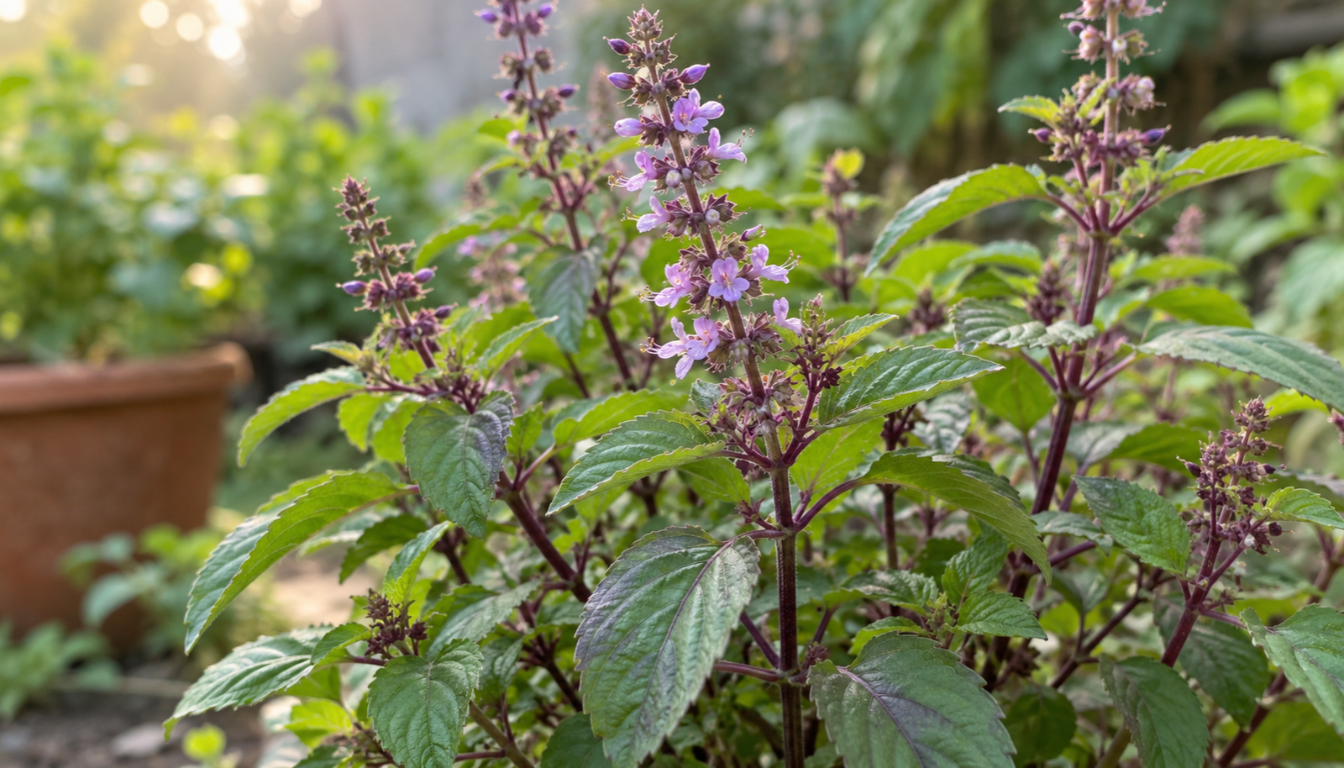
Tulsi is a herb in the mint family (Lamiaceae), native to the Indian subcontinent and also grown across Southeast Asia. Its botanical name is Ocimum tenuiflorum, which is also written Ocimum sanctum. It’s often called the “Queen of Herbs,” and the name tulsi is commonly translated as “the incomparable one.” Ayurvedic and Siddha medicine have used it for thousands of years.
Researchers describe three common types. For example, Rama tulsi has green leaves, and Krishna tulsi has purplish leaves. Both are forms of Ocimum tenuiflorum. Vana tulsi is a wild relative, Ocimum gratissimum. Most studies don’t say which type they used. In fact, only two named the type, so claims that each type has its own special benefits aren’t backed by research.
Also, Tulsi is a different plant from the sweet basil used in cooking. See our guide to the difference between basil and holy basil.
What the Research Says About Tulsi Holy Basil Benefits

Tulsi has been studied more than many herbs, but the evidence is still limited. A 2017 systematic review (Jamshidi and Cohen) found 24 human studies. Most reported favorable results with few side effects.
The limits matter, though. The studies were small, with 1,111 participants in total. They were short, lasting 2 to 13 weeks. Only 8 of the 24 used a placebo, and most were low quality by the review’s own scoring. The authors say tulsi’s effects may have been overestimated. Also, most studies used extracts, capsules, leaf powder, or leaf juice, not brewed tea.
Here is what those studies found, area by area:
| Area | What studies found | How strong is it? |
|---|---|---|
| Stress and mood | In placebo-controlled trials of tulsi extract, people reported fewer stress-related symptoms, such as fatigue and poor sleep, after about 6 weeks | The most promising area, but small and extract-based |
| Blood sugar | Several small trials in type 2 diabetes reported lower fasting and after-meal blood glucose | Early and mostly low quality |
| Cholesterol and blood pressure | Some small trials reported better lipid levels and lower blood pressure | Early and small |
| Memory and attention | In one trial of 40 healthy young adults, a 4-week course of extract improved attention and working memory, but only after about two weeks | A single small trial |
| Immune function | In one trial of 22 healthy adults, 4 weeks of extract changed some immune markers | Lab markers, not proof of fewer illnesses |
| Sleep | Sleep problems improved as part of overall stress symptoms in stress trials | No study tested sleep on its own |
The Bottom Line
The MSD Manual, a widely used medical reference, doesn’t recommend holy basil for health purposes. It says the claimed effects haven’t been confirmed in high-quality human studies, though it calls holy basil probably safe for most people. In short, tulsi is promising and worth studying, but it’s not a proven treatment for any condition.
Claims That Aren’t Supported
Some popular claims go well beyond the evidence:
- Cancer: None of the 24 trials in the 2017 review tested cancer, so Tulsi is not a treatment for it.
- Thyroid problems: Tulsi isn’t a treatment for hypothyroidism. In fact, the MSD Manual warns it might lower thyroxine levels and could make an underactive thyroid worse.
- Acne and skin infections: No trial in the review tested them, so these claims come from tradition and lab studies.
- “Adrenal fatigue”: The Endocrine Society says no scientific proof exists that adrenal fatigue is a true medical condition. However, real adrenal problems, like adrenal insufficiency, need a doctor’s diagnosis.
- Viral infections: The review included two small, low-quality trials from the 1980s, on viral hepatitis and viral encephalitis. Therefore, they’re not a basis for using tulsi instead of medical care for any viral illness.
- Detox: No study in the review tested “detoxing.”
Who Should Be Careful With Tulsi
Tulsi is probably safe for most people, and side effects appear uncommon. For example, one trial reported occasional mild nausea. But some groups should take care:
- Pregnancy and trying to conceive: In animal studies, large doses reduced the chance that a fertilized egg would implant and that a pregnancy would last to term. Avoid tulsi in these cases. There’s also no safety data for breastfeeding.
- Blood thinners and surgery: Tulsi might slow blood clotting. That could raise bleeding risk if you take blood-thinning medication, or before and after surgery.
- Diabetes medication: Tulsi might lower blood sugar. Combined with insulin or drugs like sulfonylureas, it could cause blood sugar to drop too low.
- Thyroid conditions: Tulsi might lower levels of the thyroid hormone thyroxine, so it could worsen an underactive thyroid.
- Low blood pressure: Tulsi lowered blood pressure in some small trials, so check with your doctor if yours is already low.
- Long-term use: Safety beyond about 8 to 13 weeks hasn’t been studied.
- Essential oil: Tulsi essential oil is highly concentrated. Don’t cook with it or swallow it.
If you take any medication or have a health condition, talk to your doctor before using tulsi supplements.
How to Use Tulsi
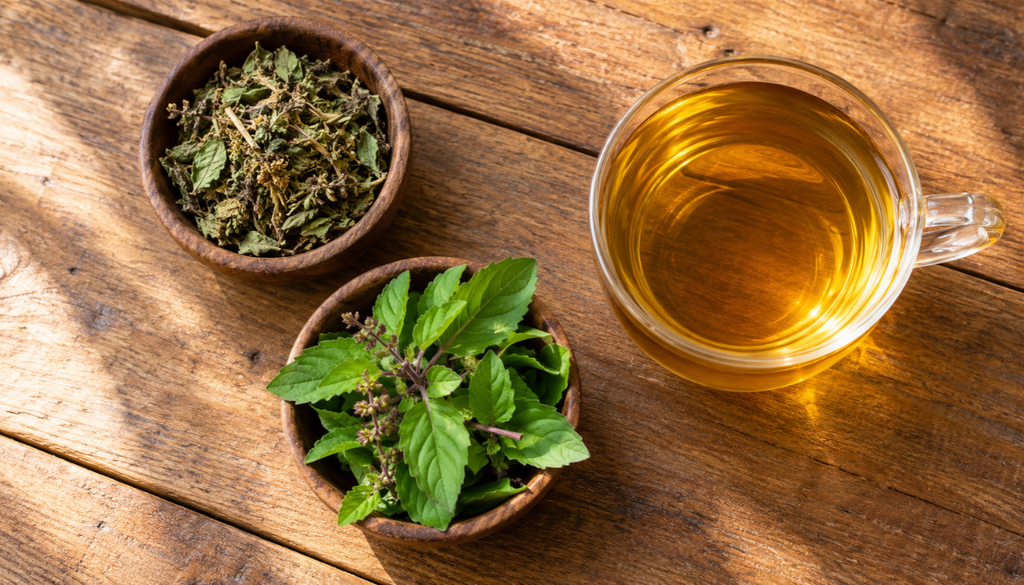
- Tea: Steep fresh or dried leaves in hot water for 5 to 10 minutes. Our [tulsi holy basil tea guide] has the full method.
- Supplements: Tulsi comes as capsules, tablets, and tinctures. Studies used doses from about 300 mg of extract to several grams of leaf powder a day, so there’s no established dose. Read the label for the plant part and amount.
- In cooking: In Thai cooking, holy basil (kaphrao) is a stir-fry staple, with a spicy, slightly sweet flavor.
- In the garden: Want to grow your own? See our Growing Medicinal Herbs guide.
Before You Go – Tulsi Holy Basil Benefits
Tulsi has a rich tradition and some encouraging early research, especially for stress and mood. But the studies are small and short, and most used extracts, so tulsi isn’t a proven treatment for any condition. Enjoy it as tea or in cooking, be cautious with supplements, and talk to your doctor first if you’re pregnant, take blood thinners or diabetes medication, or have a thyroid condition.
References – Tulsi Holy Basil Benefits
Little Herb Encyclopedia, by Jack Ritchason; N.D., Woodland Publishing Incorporated, 1995
The Ultimate Healing System, Course Manual, Copyright 1985, Don Lepore
Planetary Herbology, Michael Tierra, C.A., N.D., Lotus Press, 1988
Handbook of Medicinal Herbs, by James A. Duke, Pub. CRP Second Edition 2007
The Complete Medicinal Herbal, by Penelope Ody, Published by Dorling Kindersley
Sources
- Jamshidi, N., and Cohen, M.M. “The Clinical Efficacy and Safety of Tulsi in Humans: A Systematic Review of the Literature.” Evidence-Based Complementary and Alternative Medicine, 2017 (one author discloses consulting for a tulsi products company): https://www.ncbi.nlm.nih.gov/pmc/articles/PMC5376420/
- Saxena, R.C., Singh, R., Kumar, P., et al. “Efficacy of an Extract of Ocimum tenuiflorum (OciBest) in the Management of General Stress: A Double-Blind, Placebo-Controlled Study.” Evidence-Based Complementary and Alternative Medicine, 2012: https://pmc.ncbi.nlm.nih.gov/articles/PMC3185238/
- Sampath, S., Mahapatra, S.C., Padhi, M.M., Sharma, R., and Talwar, A. “Holy basil (Ocimum sanctum Linn.) leaf extract enhances specific cognitive parameters in healthy adult volunteers: a placebo controlled study.” Indian Journal of Physiology and Pharmacology, 2015: https://pubmed.ncbi.nlm.nih.gov/26571987/
- Mondal, S., Varma, S., Bamola, V.D., et al. “Double-blinded randomized controlled trial for immunomodulatory effects of Tulsi (Ocimum sanctum Linn.) leaf extract on healthy volunteers.” Journal of Ethnopharmacology, 2011: https://pubmed.ncbi.nlm.nih.gov/21619917/
- MSD Manual Consumer Version, “Holy Basil”: https://www.msdmanuals.com/home/special-subjects/dietary-supplements-and-vitamins/holy-basil
- PeaceHealth, “Holy Basil” (pregnancy and breastfeeding): https://www.peacehealth.org/medical-topics/id/hn-4597000
- Endocrine Society, “Adrenal Fatigue”: https://www.endocrine.org/patient-engagement/endocrine-library/adrenal-fatigue
Related Articles
Fenugreek Seeds Benefits: An Amazing Detailed Overview
Oregano Oil Benefits: A Complete Overview
Frequently Asked Questions – Tulsi Holy Basil Benefits
What are the benefits of tulsi holy basil?
Tulsi is traditionally used for stress, and early studies of extracts suggest possible benefits for stress and mood, blood sugar, and cholesterol. The research is small and short, so tulsi isn’t a proven treatment for any condition.
Is tulsi good for stress?
It’s the most promising area. Placebo-controlled trials of tulsi extract found fewer stress-related symptoms after about 6 weeks. Those studies used extracts, not tea, so a cup of tea hasn’t been tested the same way.
Can tulsi lower blood sugar?
It might. Small trials in type 2 diabetes reported lower blood glucose. That also means it could push blood sugar too low if you take insulin or drugs like sulfonylureas, so talk to your doctor first. Tulsi is not a replacement for diabetes treatment.
Is tulsi good for skin?
No human trial in the 2017 review tested skin conditions or acne. Tulsi is used traditionally and shows antimicrobial effects in lab studies, but that doesn’t make it an established skin treatment. See a dermatologist for acne or skin infections.
What are the different types of tulsi?
Rama tulsi has green leaves, Krishna tulsi has purplish leaves, and Vana tulsi is a wild relative. Most studies don’t say which type was used, so claims that each type treats different problems aren’t backed by research.
Why is tulsi sacred?
In Hinduism, tulsi is considered a sacred plant and plays a part in religious ceremonies. That cultural role is separate from its medicinal use, and this article covers only the research.
Who should avoid tulsi?
Avoid it if you’re pregnant or trying to conceive, and skip it while breastfeeding unless your doctor says otherwise. Check with your doctor first if you take blood thinners or diabetes medication, have a thyroid condition or low blood pressure, or have surgery planned.