
The Herb Prof Team researches and writes our herbal guides, drawing on published research, traditional herbal references, and hands-on growing experience.
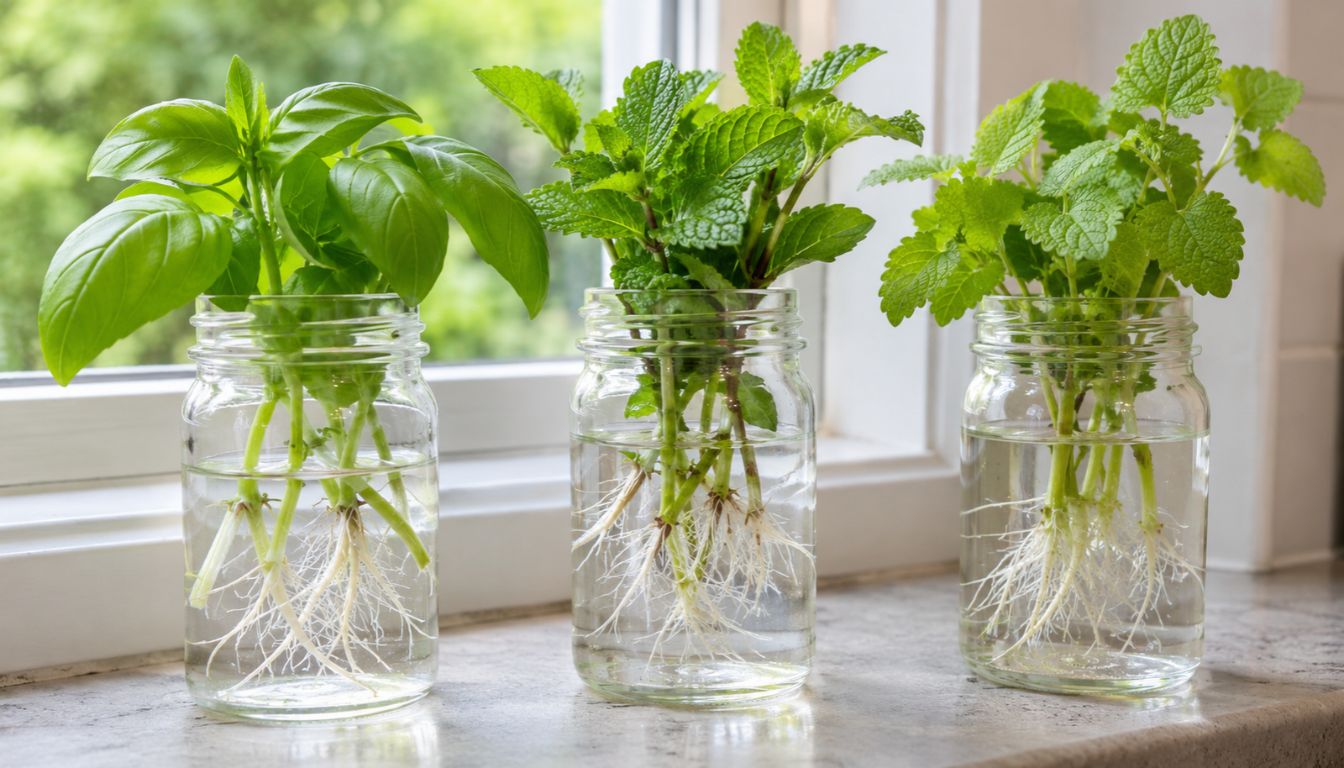
Growing herbs in water works best as a way to root cuttings, not as a permanent home for the plants. Basil and mint root easily in a jar of water, and they can then move into soil. Herbs can also grow in water for the long term, but that is hydroponic growing, and it needs the right fertilizer and light. This guide covers both methods, the best herbs to try, and the steps to follow.
Two Ways of Growing Herbs in Water
- Rooting cuttings: you place a stem cutting in plain water until roots form, then pot it up in soil.
- Hydroponic growing: the plant lives in water for good, and the water carries a nutrient solution.
The first is the simpler method for beginners. The University of Tennessee Extension says simple setups such as mason jars that grow single plants are a sensible place to start before you try complex systems.
Best Herbs for Growing Herbs in Water
Basil and mint are the easiest to start. Garden experts quoted by Gardening Etc call them vigorous growers that usually do well from a cutting, whether in soil or in water.
Woody herbs are less certain. One expert in that article says rosemary and thyme usually do better rooted in soil and can be trickier to start. Another lists them as herbs that root easily. Because the experts disagree, begin with basil or mint, then try a woody herb as an experiment.
How to Start Growing Herbs in Water From Cuttings
The New York Botanical Garden (NYBG) gives this guidance for basil cuttings, and the steps suit other soft-stemmed herbs too:
- Put the cutting in a jar of water.
- Change the water daily or every other day.
- Roots usually form in about a week and a half.
- In about two weeks the plant should be ready to move into potting soil.
- Trim the plant to about 6 inches and pot it in fresh, well-drained mix in a 4-inch pot.
- After transplanting, do not overwater.
Light for Growing Herbs in Water
Herbs need at least 4 to 6 hours of direct sunlight a day, according to the University of Tennessee Extension. A windowsill often falls short in winter, so a grow light may be needed.
Light advice varies by source. NYBG suggests fluorescent tubes 6 to 8 inches above basil, run for 12 to 16 hours a day. A University of Illinois Extension author who grows lettuce and herbs hydroponically at home keeps lights 1 to 2 inches from the plants for 14 to 16 hours. Follow the instructions that come with your light, and raise it as the plants grow.
Indoor plants also benefit from airflow. NYBG says a small fan creating a gentle breeze helps stems grow stronger. Keep plants away from direct heating and cooling vents, as the University of Tennessee Extension advises.
Growing Herbs in Water Long Term
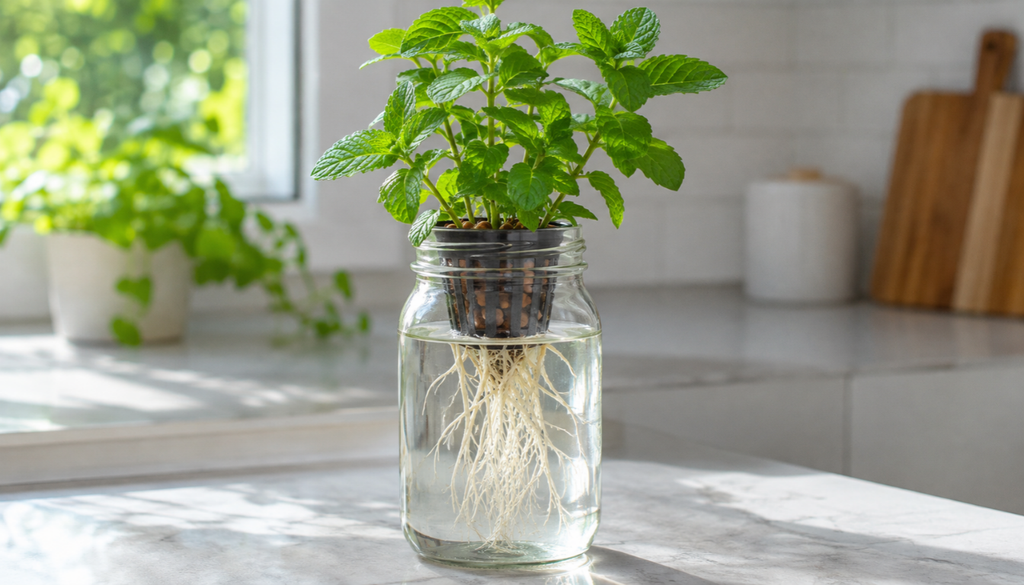
If you want plants to stay in water, you need a hydroponic fertilizer, not just plain water. The University of Tennessee Extension says it is crucial to use fertilizers designed for hydroponic growing, because the nutrient ratios differ from those in soil. At home scale, a pre-mixed liquid fertilizer that dissolves completely is the simplest option.
The University of Illinois Extension author changes the nutrient solution every two weeks and cleans the container each time. In a deep-water setup, that author says the air pump is essential, because without it the roots would not get enough oxygen. Watch leaf color and growth for signs of too many or too few nutrients.
Before You Go – Growing Herbs in Water
Growing herbs in water is easiest as a way to root basil and mint cuttings, then move them into soil. For long-term growth in water, use a fertilizer made for hydroponics and give the plants enough light.
References – Growing Herbs in Water
Little Herb Encyclopedia, by Jack Ritchason; N.D., Woodland Publishing Incorporated, 1995
The Ultimate Healing System, Course Manual, Copyright 1985, Don Lepore
Planetary Herbology, Michael Tierra, C.A., N.D., Lotus Press, 1988
Handbook of Medicinal Herbs, by James A. Duke, Pub. CRP Second Edition 2007
The Complete Medicinal Herbal, by Penelope Ody, Published by Dorling Kindersley
Sources
New York Botanical Garden. My winter basil cuttings die when I transfer them from water to soil. Why? https://libanswers.nybg.org/faq/222845 University of Illinois Extension. Using hydroponics at home. https://extension.illinois.edu/blogs/know-how-know-more/2017-03-29-using-hydroponics-home University of Tennessee Extension. Hydroponic growing (publication W1288B). https://utia.tennessee.edu/publications/wp-content/uploads/sites/269/2025/04/W1288B.pdf Gardening Etc. Do you need to stick herb cuttings in water? Here’s what garden experts say. https://gardeningetc.com/news/gardening-experts-propagating-herb-cuttings-in-water
Related Articles
10 Must-Try Herbal Remedies for Natural Healing
Frequently Asked Questions – Growing Herbs in Water
Can herbs grow in water only?
Cuttings can root in plain water, and NYBG says basil is ready for soil in about two weeks. For long-term growth, the University of Tennessee Extension says you need a fertilizer designed for hydroponic growing.
Which herbs grow best in water?
Basil and mint are the easiest to start, according to the garden experts in the Gardening Etc article. Experts disagree on rosemary and thyme, so treat those as an experiment.
How often should I change the water?
NYBG says to change the water daily or every other day while cuttings root. For a hydroponic setup, the University of Illinois Extension author changes the nutrient solution every two weeks.
Do I need a grow light?
Herbs need at least 4 to 6 hours of direct sun a day, according to the University of Tennessee Extension. If your window doesn’t give that, especially in winter, a grow light helps.