
The Herb Prof Team researches and writes our herbal guides, drawing on published research, traditional herbal references, and hands-on growing experience.
Basil for skin is a popular home-remedy idea, but the evidence is thinner than most websites suggest. In lab studies, basil extracts and oils show antibacterial and antioxidant activity. However, lab results don’t prove that a basil mask clears acne or treats a skin condition. This guide covers what’s known, what isn’t, and how to try basil on your skin more safely.
What the Research Says About Basil for Skin
Sweet basil (Ocimum basilicum) is rich in aromatic oils and phenolic compounds. Most research on basil and skin looks at acne, and nearly all of it happens in the lab.
- Basil essential oil inhibited Cutibacterium acnes, a bacterium linked to acne, in lab tests. One study found it worked at a concentration of about 2%.
- A basil water extract also inhibited C. acnes in the dish. In that study, its inhibition zone was larger than that of 0.1% salicylic acid. It also showed antioxidant activity.
- The best-known clinical trial used a different species. In a trial of 126 people, oil from Ocimum gratissimum reduced acne lesions faster than benzoyl peroxide. That isn’t the sweet basil in your kitchen, and it was a formulated product, not a homemade mask.
In the research we reviewed, no clinical trial tested a homemade basil mask or toner. So the honest summary is that basil looks promising in the lab, but it isn’t proven on skin.
Claims That Don’t Hold Up
Some websites also say basil treats eczema, psoriasis, dark spots, and sunburn. The studies we found looked at acne, and none of them tested those conditions. Even so, eczema and psoriasis are medical conditions that need a dermatologist’s care.
What Works for Acne, According to Dermatologists
If acne is why you’re searching, the best-supported options are different from basil. The American Academy of Dermatology’s guidelines list benzoyl peroxide and topical retinoids as first-line options. Benzoyl peroxide is sold over the counter, and so is adapalene 0.1% gel, a retinoid. Other retinoids need a prescription. Salicylic acid, also sold over the counter, gets a conditional recommendation because the evidence for it is limited. For dark spots left after a pimple clears, azelaic acid is on the guideline list too.
If your acne is severe, painful, or leaves scars, a dermatologist can prescribe stronger treatments. If you’re pregnant, ask your doctor before using any acne product.
Safety First: Using Basil on Your Skin
- Concentration matters. In one review, Ocimum oil irritated skin at 5% in some formulations, while 2% did not. Never put undiluted essential oil on your skin.
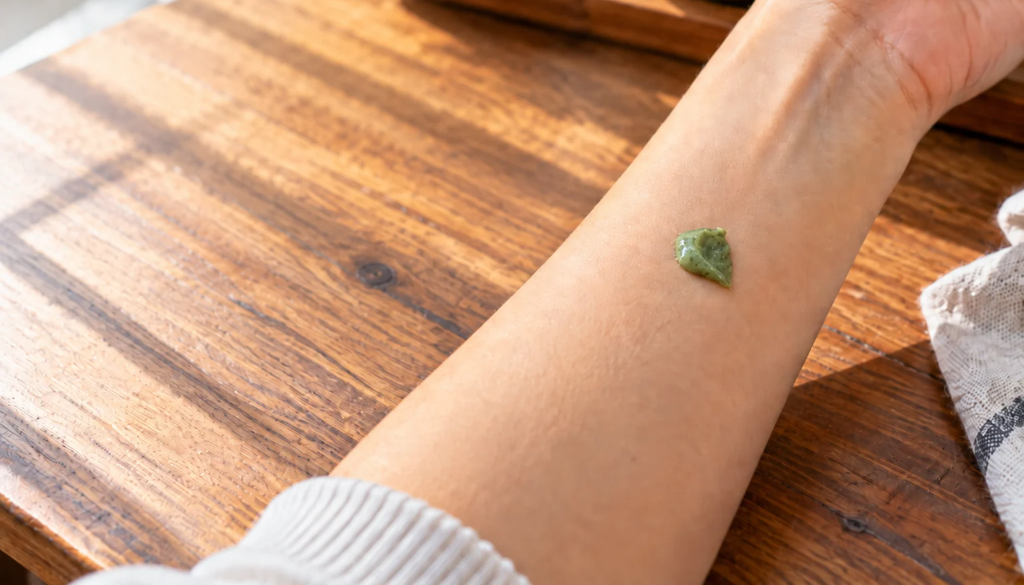
- Patch test first. Dab a small amount on your inner forearm, and wait 24 hours. Skip it if you see redness, itching, or burning.
- Skip citrus juice. Lemon or lime juice on skin, followed by sun, can cause painful redness and blisters. It can also leave dark patches that last weeks to months. This is called phytophotodermatitis.
- Don’t store homemade basil oil. Fresh leaves in oil can grow bacteria and mold. Extension guidance for food says to refrigerate fresh herbs in oil and use them within 4 days. For skin, skip it, or choose a commercial product made for skin.
- Avoid broken, inflamed, or infected skin, and keep basil away from your eyes.
- See a dermatologist for severe, scarring, or painful acne.
Simple Ways to Try Basil on Your Skin
If you want to try basil anyway, keep it simple, and patch test first.
Basil toner: Steep a handful of fresh basil leaves in hot water for about 10 minutes. Strain it and let it cool. Dab it on with a cotton pad. Make a fresh batch each time, or keep it in the fridge for no more than a day.
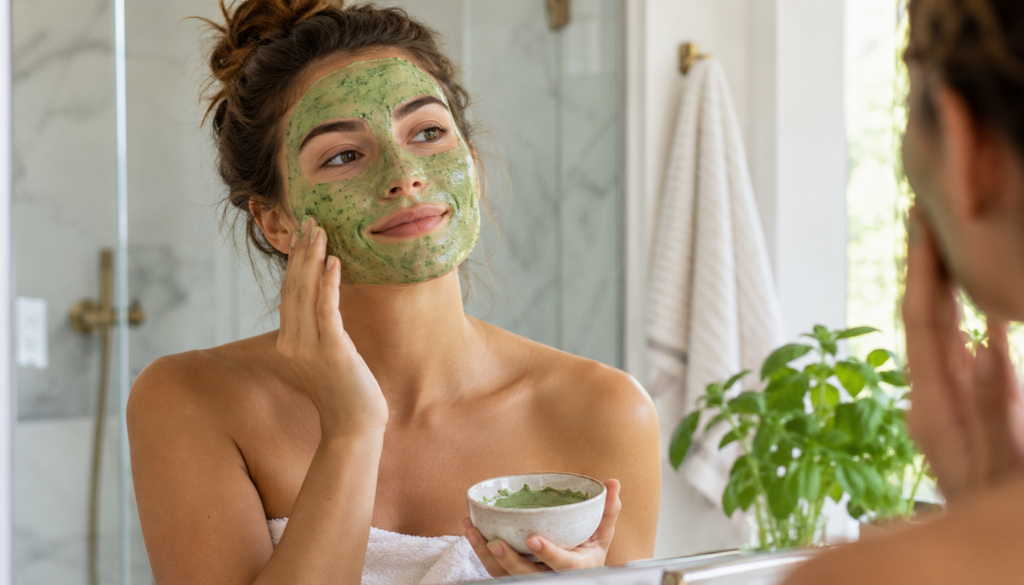
Basil and honey mask: Crush a handful of fresh leaves and mix them with a tablespoon of honey. Spread it on clean skin, leave it for 10 to 15 minutes, and rinse with warm water.
Use either one once or twice a week at most, and stop if your skin gets irritated. Treat them as gentle extras, not treatments. Fresh leaves work best for masks. Dried basil works for a toner, since you steep it in hot water.
Does Eating Basil Help Your Skin?
Basil is a healthy herb, but there’s no good evidence that eating it improves your skin. In fact, the small amounts used in cooking, adds little in the way of vitamins or minerals. A varied diet matters more.
To whip up this luxurious mask, mash half an avocado and mix it with a handful of crushed basil leaves. The creaminess of the avocado combined with the soothing properties of basil creates a hydrating mask that feels like a gentle hug for your face. Apply it generously, and let it sit for about 15-20 minutes. Rinse it off, and you’ll be left with skin that feels soft, supple, and oh-so-happy.
Before You Go – Basil for Skin
Basil for skin has promising lab results, but no proof from clinical trials of home use. However, if you try it, keep it gentle: patch test, skip citrus, and don’t store homemade oils. For acne or any skin condition that bothers you, a dermatologist is the better route. For more on basil, see our guides to growing basil.
References – Basil For Skin
Little Herb Encyclopedia, by Jack Ritchason; N.D., Woodland Publishing Incorporated, 1995
The Ultimate Healing System, Course Manual, Copyright 1985, Don Lepore
Planetary Herbology, Michael Tierra, C.A., N.D., Lotus Press, 1988
Handbook of Medicinal Herbs, by James A. Duke, Pub. CRP Second Edition 2007
The Complete Medicinal Herbal, by Penelope Ody, Published by Dorling Kindersley
Sources
- Parvizi et al., “Medicinal Plants for Acne Vulgaris: An Evidence-Based Review of Treatments Promoted by Social Media.” Journal of Cosmetic Dermatology, 2026: onlinelibrary.wiley.com
- “Evaluation of in vitro anti-acne activities of Ocimum basilicum L. water extract”: sciencedirect.com
- Hapsari, I.P., and Feroniasanti, Y., “Phytochemical screening and in vitro antibacterial activity of sweet basil leaves essential oil against Cutibacterium acnes”: pubs.aip.org
- Cleveland Clinic, “Margarita Burn: Why Lime Juice and Sun Don’t Mix”: health.clevelandclinic.org
- Oregon State University Extension, “Herbs and Vegetables in Oil”: extension.oregonstate.edu
- American Academy of Dermatology, “Updated guidelines for the management of acne”: aad.org
- Reddy, D.S. et al. / AAD Work Group, “Guidelines of care for the management of acne vulgaris,” Journal of the American Academy of Dermatology: jaad.org
Related Articles
8 Incredible Flowers to Plant in September
Top 10 Herbs For Energy: Natural Power-Up Now!
Does Ashwagandha Improve Health? 4 Incredible Benefits
Frequently Asked Questions – Basil for Skin
Can basil help with acne?
In lab studies, basil oil and extracts inhibit acne-associated bacteria. However, no clinical trial has shown that a homemade basil mask clears acne. For persistent acne, see a dermatologist.
Is basil safe to put on skin?
Fresh leaves are generally low risk, but any plant can cause irritation or allergy. Patch test first, and stop if your skin reacts.
Can I use basil essential oil on my face?
Not undiluted. In one review, Ocimum oil irritated skin at 5%, while 2% did not. A commercial product made for skin is safer than mixing your own.
Can basil treat eczema or psoriasis?
No. Both conditions need medical care, and basil isn’t a proven treatment for either.
Can basil help with sunburn?
Basil isn’t an established sunburn treatment. Cool compresses and sun protection help, and a blistering or severe sunburn needs a doctor.
How often can I use a basil mask?
Once or twice a week at most, and stop if irritation appears.
Does eating basil help my skin?
There’s no good evidence that it does. Basil is a healthy herb, but a varied diet matters more.
Can I use dried basil instead of fresh?
Fresh is better for masks. Dried basil works in a toner, since you steep it in hot water.