
The Herb Prof Team researches and writes our herbal guides, drawing on published research, traditional herbal references, and hands-on growing experience.
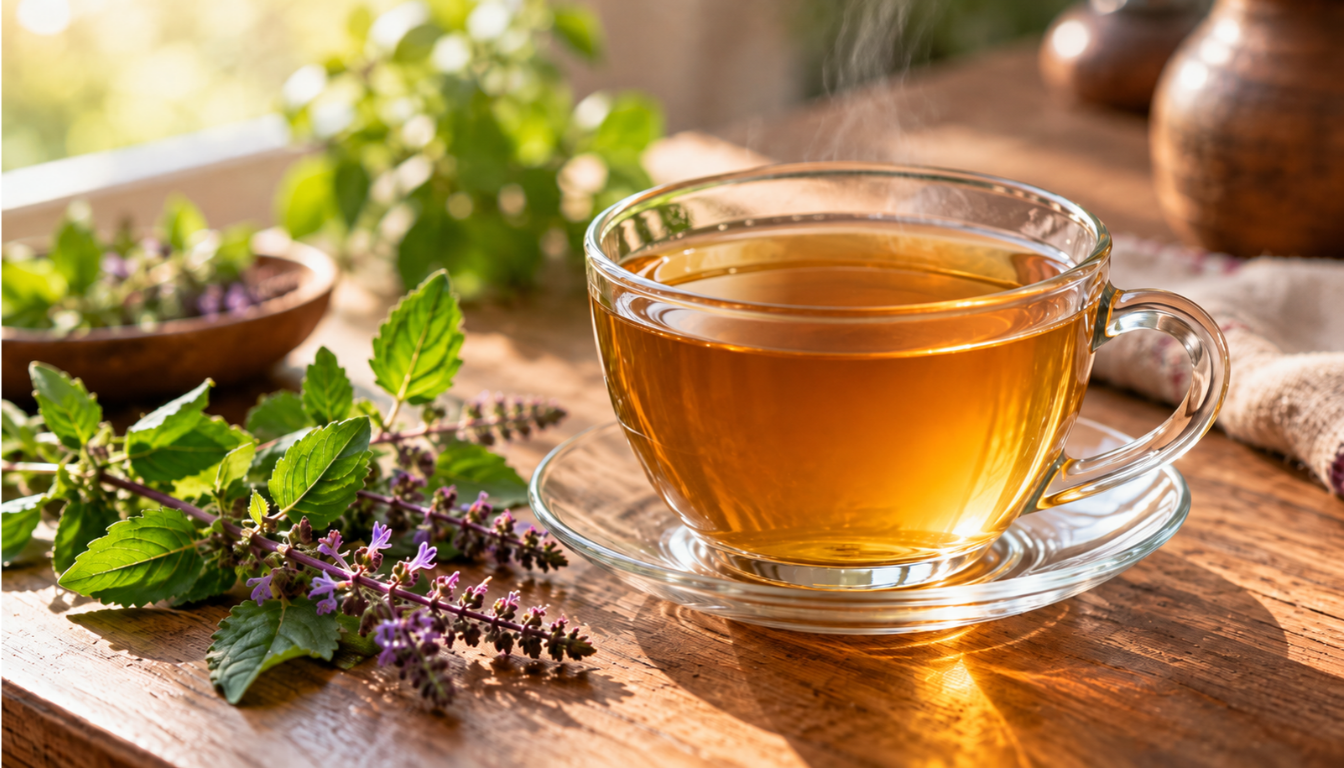
Tulsi holy basil tea is an herbal infusion made from the leaves of the tulsi plant, a sacred herb in Ayurvedic tradition. It has a rich, earthy flavor with a hint of spice, and it’s naturally caffeine-free. People drink it to unwind, and many wonder what the research really says.
This guide covers what studies show, who should be careful, and how to brew a good cup.
What Is Tulsi Holy Basil Tea?
Tulsi (Ocimum tenuiflorum, also called Ocimum sanctum) is a herb native to the Indian subcontinent. Ayurvedic medicine has used it for thousands of years. To make the tea, you steep the leaves, fresh or dried, in hot water.
Researchers describe three common types. Rama tulsi has green leaves, Krishna tulsi has purplish leaves, and Vana tulsi is a related species (Ocimum gratissimum). Tulsi is a different plant from the sweet basil in your kitchen. See our guide to the [difference between basil and holy basil] for more.
What the Research Shows
Tulsi has been studied more than most herbal teas, but the evidence is still limited. A 2017 systematic review (Jamshidi and Cohen) found 24 human studies. Most reported favorable results for blood sugar, blood pressure, cholesterol, stress, and mood, with few side effects.
There are important limits, though. The studies were small, with 1,111 participants in total. They were short, lasting 2 to 13 weeks. Only 8 of the 24 used a placebo, and most were low quality by the review’s own scoring. The authors say tulsi’s effects may have been overestimated. They add that more rigorous research is needed before recommending it for any specific condition.
Most of these studies also didn’t test tea. They used extracts, capsules, leaf powder, or leaf juice, in a wide range of doses. Results from those forms can’t be assumed to apply to a cup of tea.
Stress and mood have the strongest evidence. In one randomized, placebo-controlled trial, 150 stressed adults took a tulsi extract for 6 weeks. They reported fewer stress-related symptoms, such as fatigue and poor sleep (Saxena et al., 2012). That was a concentrated extract, not tea. Whether a daily cup does the same hasn’t been established.
Other studies have looked at blood sugar, blood pressure, and cholesterol. Those results are early. Tulsi tea isn’t a treatment for diabetes, high blood pressure, or high cholesterol, so talk to your doctor if you have any of them.
The MSD Manual, a widely used medical reference, doesn’t recommend holy basil for health purposes. It says the claimed effects haven’t been confirmed in high-quality human studies. It also calls holy basil probably safe for most people. A fair summary: tulsi tea is a pleasant, traditional drink. Early research on tulsi extracts is promising, but not conclusive.
What People Say Tulsi Tea Does, and What We Know

Tulsi tea is credited with many benefits. Here is how the common claims hold up.
| Claim | What’s behind it | Reality check |
|---|---|---|
| Stress and mood | Early human trials of tulsi extracts | Promising, but not tested with tea |
| Immune support | Small studies of extracts measured immune markers in healthy adults | None of the studies in the 2017 review tested cold prevention |
| Digestion | Traditional use: Ayurveda has used tulsi tea for stomach and liver complaints | The human studies in the review didn’t focus on digestion |
| Breathing and congestion | Traditional use for cough and asthma, plus one small 1983 trial of 20 people with asthma using leaf tablets | Too limited to support claims about tea |
| Antioxidants | Tulsi shows antioxidant activity in lab and animal studies | Lab findings don’t show a health effect from a cup of tea |
Therefore, tulsi tea isn’t a treatment for a cold, asthma, or a digestive condition. See a doctor if you have ongoing symptoms.
Who Should Avoid Tulsi Tea or Check With a Doctor First
Tulsi is probably safe for most people, but it has some real cautions:
- Pregnancy and trying to conceive: In animal studies, large doses reduced the chance that a fertilized egg would implant and that a pregnancy would last to term. Avoid tulsi if you’re pregnant or trying to become pregnant. There’s also no safety data for breastfeeding.
- Blood thinners and surgery: Tulsi might slow blood clotting. That could raise bleeding risk if you take blood-thinning medication, or before and after surgery.
- Diabetes medication: Tulsi might lower blood sugar. Combined with insulin or drugs like sulfonylureas, it could cause blood sugar to drop too low.
- Thyroid conditions: Tulsi might lower levels of the thyroid hormone thyroxine, so it could worsen an underactive thyroid.
- Long-term daily use: People in India traditionally drink tulsi daily, but long-term safety hasn’t been formally studied. The longest human study ran 13 weeks, and the MSD Manual notes that safety beyond 8 weeks isn’t established.
Much of this safety information comes from animal studies and concentrated extracts. A cup of tea likely delivers less, but the cautions are still worth taking seriously if they apply to you.
How to Make Tulsi Holy Basil Tea
Ingredients
- Fresh tulsi leaves: about 10 to 15 for 2 cups of water (dried leaves work too, so follow the package for amounts)
- Water: 2 cups
- Optional: honey, lemon slices, or fresh ginger
Steps
1. First, bring 2 cups of water to a boil.
2. Next, put the tulsi leaves in a teapot or large mug.
3. Then pour the hot water over the leaves and cover.
4. Steep for 5 to 10 minutes.
5. After that, strain out the leaves.
6. Finally, sweeten with honey if you like, and add lemon or ginger.
Enjoy it warm, or let it cool and serve it over ice.
Tulsi Tea Blends and Flavors
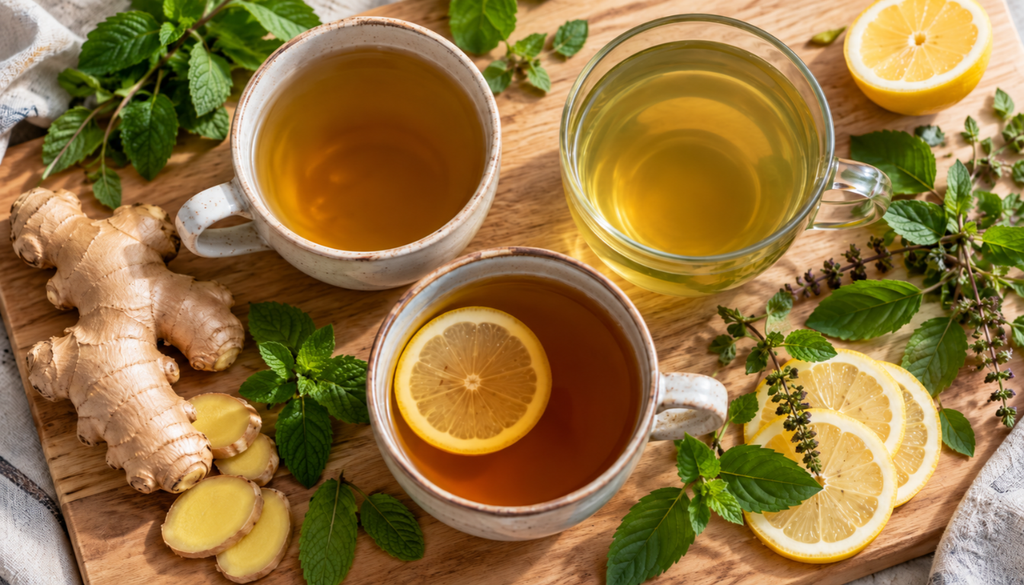
Tulsi blends well with other flavors:
- Tulsi and ginger adds a spicy kick.
- Tulsi and mint gives a cool, refreshing finish.
- Tulsi and lemon tastes bright and zesty.
- Vanilla, chai spices, and berries make sweeter or cozier versions.
If you buy a ready-made blend, read the label because some tulsi blends add green or black tea, which contain caffeine.
Before You Go – Tulsi Holy Basil Tea
Overall, tulsi holy basil tea is a pleasant, caffeine-free herbal tea with deep roots in Ayurvedic tradition. The research on tulsi is promising but early, and most of it used extracts rather than tea. Enjoy it for its flavor and the ritual of a warm cup, not as a treatment for any condition.
Skip it, or check with your doctor first, if you’re pregnant, take blood thinners or diabetes medication, or have a thyroid condition. For more, see our Tulsi Holy Basil Benefits guide.
References – Tulsi Holy Basil Tea
Little Herb Encyclopedia, by Jack Ritchason; N.D., Woodland Publishing Incorporated, 1995
The Ultimate Healing System, Course Manual, Copyright 1985, Don Lepore
Planetary Herbology, Michael Tierra, C.A., N.D., Lotus Press, 1988
Handbook of Medicinal Herbs, by James A. Duke, Pub. CRP Second Edition 2007
The Complete Medicinal Herbal, by Penelope Ody, Published by Dorling Kindersley
Sources
- Jamshidi, N., and Cohen, M.M. “The Clinical Efficacy and Safety of Tulsi in Humans: A Systematic Review of the Literature.” Evidence-Based Complementary and Alternative Medicine, 2017 (one author discloses consulting for a tulsi products company): https://www.ncbi.nlm.nih.gov/pmc/articles/PMC5376420/
- Saxena, R.C., Singh, R., Kumar, P., et al. “Efficacy of an Extract of Ocimum tenuiflorum (OciBest) in the Management of General Stress: A Double-Blind, Placebo-Controlled Study.” Evidence-Based Complementary and Alternative Medicine, 2012: https://pmc.ncbi.nlm.nih.gov/articles/PMC3185238/
- MSD Manual Consumer Version, “Holy Basil”: https://www.msdmanuals.com/home/special-subjects/dietary-supplements-and-vitamins/holy-basil
- PeaceHealth, “Holy Basil” (pregnancy and breastfeeding): https://www.peacehealth.org/medical-topics/id/hn-4597000
Check the Following Articles
White vs Brown Egg: Which One Should You Choose?
What Is Arrowroot? Discover Its Uses and Health Benefits
Top 3 Healthier Substitutes for Butter
Planting Onions from Seed: A Step-by-Step Guide
Frequently Asked Questions – Tulsi Holy Basil Tea
Is tulsi tea the same as holy basil tea?
Yes. Tulsi is the Hindi name for holy basil, so the two names describe the same herb.
What is tulsi tea good for?
Tulsi is traditionally used in Ayurveda, and early research has looked at stress, mood, and blood sugar, mostly with extracts. Tea hasn’t been well studied. Enjoy it as a pleasant herbal drink, not a treatment.
Does tulsi tea have caffeine?
No. Pure tulsi comes from a different plant than black and green tea and has no caffeine. Blends labeled “tulsi green tea” contain green tea leaves, which do.
Is it safe to drink tulsi tea every day?
The MSD Manual calls holy basil probably safe for most people, but notes that safety beyond 8 weeks hasn’t been studied. If you take medication or have a health condition, check with your doctor before drinking it daily.
Can I drink tulsi tea while pregnant?
It’s best to avoid it. Animal studies of large doses showed effects on implantation and pregnancy, and there’s no safety data for pregnancy or breastfeeding.
Is tulsi tea good for digestion?
Tulsi tea has a traditional use for stomach complaints in Ayurveda. The human studies in the 2017 review focused on other areas, so they don’t show that it improves digestion. If you have ongoing digestive symptoms, see a doctor.
Can tulsi tea help with coughs or congestion?
Tulsi has a traditional use for coughs, and a warm drink can feel soothing. But no study in the 2017 review tested tulsi tea for coughs or congestion, so we can’t say it helps. See a doctor if symptoms are severe or last more than a few days.
How often should I drink tulsi tea?
There’s no established amount for tea. Tulsi is traditionally drunk daily, but long-term safety hasn’t been formally studied. If you take medication or have a health condition, ask your doctor how often is right for you.
What’s the difference between tulsi and regular basil?
Tulsi (Ocimum tenuiflorum) is a different species from the sweet basil (Ocimum basilicum) used in cooking. See our guide to the difference between basil and holy basil.