
The Herb Prof Team researches and writes our herbal guides, drawing on published research, traditional herbal references, and hands-on growing experience.
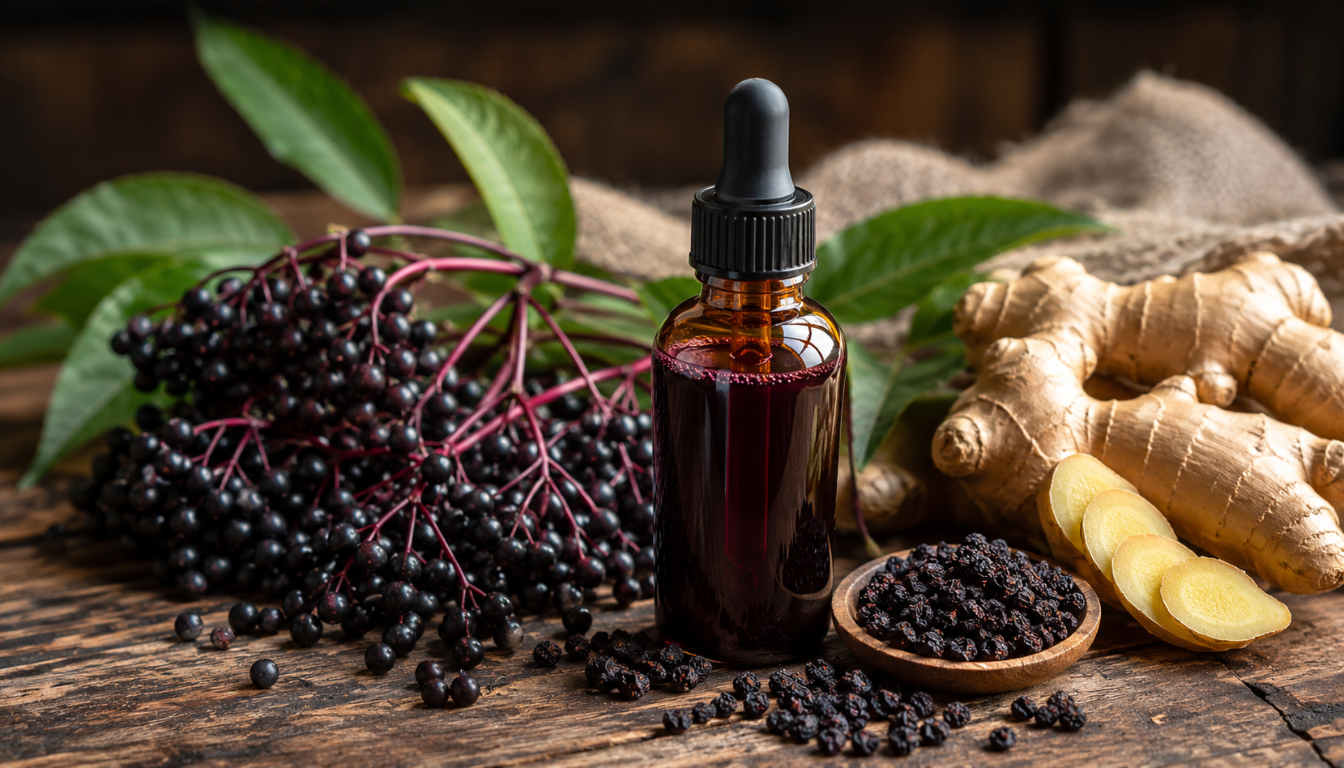
Elderberry tincture is one of the most useful preparations you can make at home, and this elderberry tincture recipe is simpler than you might think. Concentrated, long-lasting, and easy to take, it captures the immune-supporting power of elderberries in a form that keeps for years rather than weeks. This guide walks you through everything you need, from choosing your berries to bottling your finished tincture, with clear steps and the safety information you need to do it properly.
What Is Elderberry Tincture?
A tincture is a concentrated herbal extract made by steeping plant material in alcohol. The alcohol draws out the active compounds from the berries and preserves them, giving you a shelf-stable remedy that is far more potent than a tea and more concentrated than a syrup.
Elderberry tincture is typically taken in small doses, a few drops to a teaspoon at a time, either directly under the tongue or added to water or juice. It is particularly valued during cold and flu season, but many people take it year-round as a daily immune tonic.
Understanding Elderberries
Botanical Profile
Elderberry (Sambucus nigra) is a small, dark purple berry that grows on the elder tree, native to Europe and widely naturalised across North America. It has a long history in European folk medicine, where it was used to treat respiratory infections, fevers, and general immune weakness. Today it is one of the most researched herbal immune remedies available.
The berries are rich in flavonoids, anthocyanins, and vitamin C, compounds that give elderberry its antioxidant and antiviral reputation. They are typically harvested in late summer and early autumn when fully ripe and deeply coloured.
Health Benefits
Elderberry is best known for its immune-supporting properties. Multiple clinical studies suggest that standardised elderberry extracts can reduce the duration and severity of cold and flu symptoms. It is also used as a general antioxidant tonic and has shown anti-inflammatory properties in laboratory research.
Beyond immune support, elderberry tincture has traditionally been used for:
- Respiratory infections and seasonal colds
- Sore throats and mild fever support
- General antioxidant and anti-inflammatory support
- Reducing oxidative stress during periods of illness or high stress
Safety and Precautions
Raw elderberries contain naturally occurring compounds called cyanogenic glycosides, which can cause nausea, vomiting, and digestive upset if consumed in large quantities when raw. Steeping in high-proof alcohol neutralises this risk, as does cooking. Always use fully ripe berries as unripe berries have higher levels of these compounds.
Before making your tincture:
- Remove all stems and leaves – these contain higher concentrations of problematic compounds
- Use only ripe, dark purple berries – never green or unripe ones
- Do not eat raw elderberries in large amounts
- Black elderberry (Sambucus nigra) is the correct species – avoid red elderberry (Sambucus racemosa), which is not used medicinally
What You Need for Elderberry Tincture Recipe
Ingredients
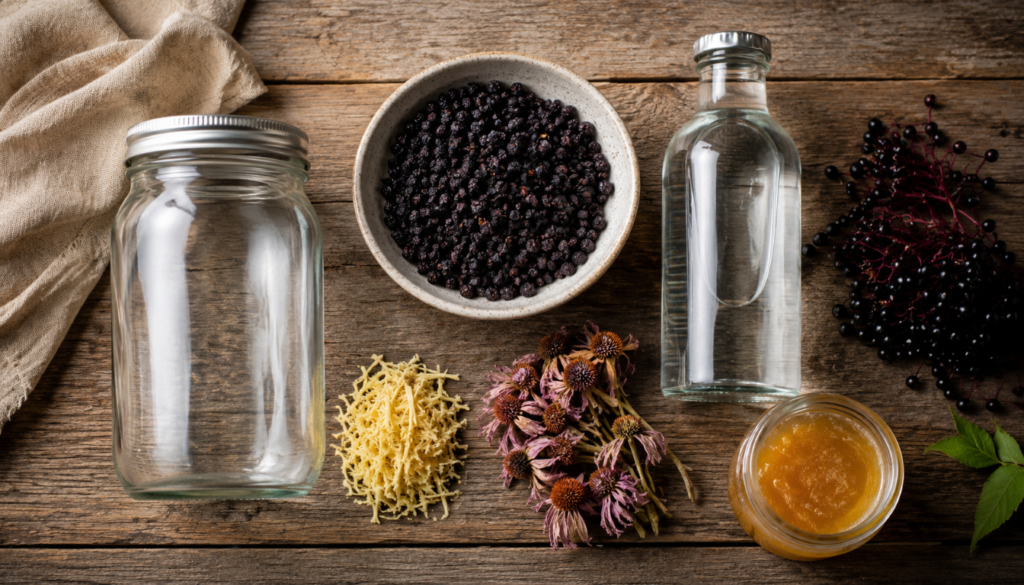
- 1 cup dried elderberries (or 2 cups fresh)
- 2 cups 80–100 proof vodka (40–50% alcohol) – brandy also works well
- 1 tablespoon fresh ginger, grated (optional but recommended)
- 1 teaspoon dried echinacea root or flowers (optional – adds immune-boosting synergy)
- Raw honey to taste (optional – add after straining if desired)
On alcohol choice: Vodka at 80–100 proof (40–50% ABV) is the standard for elderberry tinctures. This alcohol concentration is high enough to extract the active compounds and preserve the tincture long-term, but not so high that it becomes harsh to take. Brandy works equally well and adds a warmer, slightly sweeter flavour.
Equipment
- 1 quart-sized mason jar with a tight-fitting lid
- Fine-mesh strainer or cheesecloth
- Dark amber glass dropper bottles or storage bottles
- Labels
- A clean funnel
Sterilise everything before use. Wash all jars, bottles, and funnels in hot soapy water, then boil in water for 10 minutes and allow to air dry completely. This prevents contamination and extends the shelf life of your tincture.
Elderberry Tincture Recipe: Step by Step
Preparation time: 15 minutes
Infusion time: 4–6 weeks
Yield: Approximately 1.5–2 cups of finished tincture
Step 1: Prepare your berries
If using fresh elderberries, remove all stems carefully using a fork and rinse thoroughly. If using dried elderberries, inspect them and remove any stems that remain. Place the berries in your sterilised mason jar.
Step 2: Add optional herbs
If using ginger and echinacea, add them directly to the jar with the elderberries. These are optional but create a more rounded immune-supporting tincture.
Step 3: Pour over the alcohol
Pour the vodka or brandy over the berries, ensuring they are completely submerged. Leave about an inch of space at the top of the jar. If the berries float up above the liquid, press them down and add a little more alcohol to cover.
Step 4: Seal and store
Place the lid on tightly, shake well, and store the jar in a cool, dark place, a kitchen cupboard away from heat is ideal. Shake the jar every few days to encourage extraction.
Step 5: Infuse for 4–6 weeks
Leave the tincture to infuse for a minimum of four weeks. Six weeks produces a more potent result. The liquid will turn a deep, rich purple-red as the active compounds extract into the alcohol.
Step 6: Strain and bottle
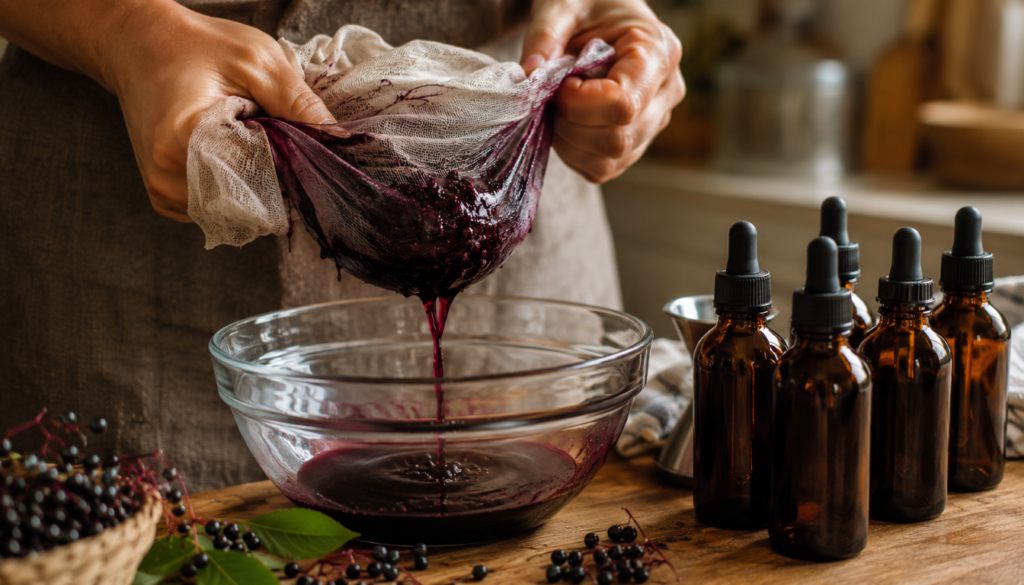
After 4–6 weeks, strain the tincture through a fine-mesh strainer or cheesecloth into a clean bowl or jug. Press the berries firmly to extract every drop of liquid. Discard the spent berry material.
Step 7: Add honey (optional)
If you would like a slightly sweetened tincture, stir in raw honey to taste at this stage. Start with a teaspoon and adjust. Note that adding honey will slightly reduce the shelf life.
Step 8: Bottle and label
Pour the finished tincture into dark amber glass dropper bottles using a clean funnel. Label each bottle clearly with:
- Contents (Elderberry Tincture)
- Date of production
- Alcohol base used
- Recommended dosage
Variations
This elderberry tincture recipe can also be adapted if you prefer to avoid alcohol. Here are the main alternatives.
Alcohol-free version (glycerin-based)
Replace the vodka with food-grade vegetable glycerin. Use the same ratio and infusion time. Glycerin extracts somewhat less efficiently than alcohol and has a shorter shelf life (around 1–2 years), but it is a good option for those avoiding alcohol or giving the tincture to older children. Note: glycerin-based tinctures are not suitable for diabetics in large amounts due to their effect on blood sugar.
Apple cider vinegar version
Replace the vodka with raw, unfiltered apple cider vinegar. This produces a milder preparation with a shorter shelf life (6–12 months) and should be refrigerated. It is the weakest extraction method of the three but is alcohol-free and widely tolerated.
Troubleshooting
- Tincture too strong – dilute with a small amount of water or glycerin before bottling
- Tincture too weak – add more dried berries and infuse for an additional 1–2 weeks
- Berries not fully submerged – top up with more alcohol immediately to prevent mould
Storage and Shelf Life
Store your finished tincture in dark amber glass bottles, away from heat and direct light. A cool cupboard or drawer is ideal. Light and heat are the two main causes of tincture degradation.
Shelf life:
- Alcohol-based (vodka/brandy): 2–3 years
- Glycerin-based: 1–2 years
- Apple cider vinegar-based: 6–12 months (refrigerate)
Before each use, check the tincture. If the colour has faded significantly, the smell is off, or the taste seems flat or unusual, discard it and make a fresh batch.
How to Use Elderberry Tincture
Dosage Guidelines
| User | Preventative dose | Acute dose (illness) |
|---|---|---|
| Adults | ½ tsp (2.5ml) 1–2x daily | 1 tsp (5ml) 3x daily |
| Children 6–12 | ¼ tsp (1.25ml) once daily | ½ tsp (2.5ml) 2x daily |
| Children under 6 | Consult a healthcare professional | Consult a healthcare professional |
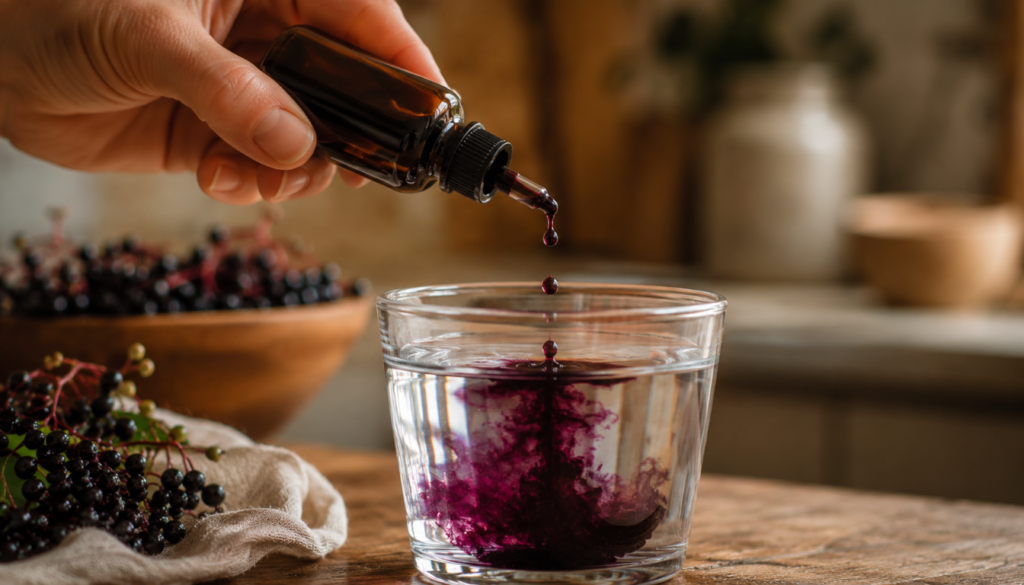
Take at the first sign of symptoms for best results. The tincture can be taken directly under the tongue, added to a small glass of water, or stirred into juice or herbal tea.
When to Use It
- Daily during cold and flu season as a preventative tonic
- At the first sign of symptoms like sore throat, fatigue, sniffles
- After exposure to illness after travelling, crowded environments, contact with sick individuals
- During recovery to support the immune system as it rebuilds
Combining With Other Herbs
Elderberry pairs well with several other immune-supporting herbs:
- Echinacea – stimulates white blood cell activity; excellent combined with elderberry for acute infections
- Ginger – anti-inflammatory and warming; supports circulation and reduces nausea
- Garlic – potent antimicrobial; add a clove or two during the infusion stage for a more powerful preparation
- Rosehip – high in vitamin C; supports the antioxidant effect of elderberry
Who Should Avoid Elderberry Tincture
- Pregnant and breastfeeding women – insufficient safety data; avoid unless advised by a healthcare professional
- People with autoimmune conditions – elderberry stimulates immune activity, which may be contraindicated in conditions such as lupus, rheumatoid arthritis, or multiple sclerosis
- People taking immunosuppressant medications – the immune-stimulating effect of elderberry may work against these drugs
- People taking diuretics – potential interaction; consult your doctor
- Children under 1 year – never give honey-containing preparations to infants under 12 months due to the risk of botulism
Always consult your doctor or a qualified medical herbalist before starting elderberry tincture if you have any existing health condition or take regular medication.
Elderberry in Traditional Medicine
Elderberry has been used medicinally for thousands of years across multiple cultures. In European folk medicine it was a primary remedy for respiratory infections, fevers, and winter illness. Native American healers used elder preparations for infections, wounds, and fever reduction. In Traditional Chinese Medicine, elder has been used for joint pain and rheumatic conditions.
Today elderberry occupies a respected position in both traditional herbalism and evidence-based complementary medicine, one of the few herbs where traditional use and modern clinical research are broadly aligned.
Sustainable Foraging and Growing
If you would like to use fresh, wild-foraged elderberries, identify the plant carefully before picking. Elderberry (Sambucus nigra) has flat-topped clusters of small dark purple berries in late summer. Never confuse it with dwarf elder (Sambucus ebulus), which is toxic and has berries that point upward rather than drooping downward.
When foraging, take no more than a third of the berries from any single plant. Leave the rest for wildlife and future harvests.
Growing elderberries at home is straightforward. They prefer a sunny position with well-drained, moderately fertile soil. A single established bush can produce several kilos of berries annually and requires very little maintenance once established.
Before You Go – Elderberry Tincture Recipe
Elderberry tincture is one of the most rewarding preparations to make at home. It is simple to produce, genuinely effective, and far more cost-efficient than commercial equivalents. Made properly and stored well, a single batch will last you through several cold and flu seasons.
For more on using elderberry in your daily wellness routine, see our guide to elderberry syrup, a gentler alcohol-free preparation that is ideal for everyday use and the whole family.
References – Elderberry Tincture Recipe
Little Herb Encyclopedia, by Jack Ritchason; N.D., Woodland Publishing Incorporated, 1995
The Ultimate Healing System, Course Manual, Copyright 1985, Don Lepore
Planetary Herbology, Michael Tierra, C.A., N.D., Lotus Press, 1988
Handbook of Medicinal Herbs, by James A. Duke, Pub. CRP Second Edition 2007
The Complete Medicinal Herbal, by Penelope Ody, Published by Dorling Kindersley
Related Articles
Elderberry Syrup Recipe: Natural Cold and Flu Defence
Herbal Face Food Review: Everything You Need To Know!
Alcohol Tincture: What It Is and How to Make It?
Frequently Asked Questions – Elderberry Tincture Recipe
What is the difference between elderberry tincture and elderberry syrup?
A tincture uses alcohol as the solvent, producing a highly concentrated, long-lasting extract taken in small doses. A syrup is water-based with a sweetener such as honey, milder in concentration, and has a shorter shelf life of two to three weeks in the refrigerator. Tinctures are better for therapeutic use; syrups are more suitable for daily preventative use and children.
Can I make elderberry tincture without alcohol?
Yes. Replace the vodka with food-grade vegetable glycerin for a glycerin-based tincture, or with raw apple cider vinegar for a vinegar-based preparation. Both are weaker extractions than alcohol and have shorter shelf lives, but are good alternatives for those avoiding alcohol.
How long does elderberry tincture take to make?
The infusion period is four to six weeks. Preparation and bottling take around 15–20 minutes. Six weeks produces a noticeably more potent tincture than four weeks.
What proof vodka should I use?
Use 80–100 proof (40–50% ABV) vodka. This range extracts the active compounds efficiently and preserves the tincture long-term. Anything below 40% ABV may not preserve the tincture adequately.
How long does homemade elderberry tincture last?
An alcohol-based tincture stored in a dark amber bottle away from heat and light will keep for two to three years. Glycerin-based preparations last one to two years, and vinegar-based preparations last six to twelve months and should be refrigerated.
Is elderberry tincture safe for children?
Children over six can take a reduced dose under parental supervision. Always consult a healthcare professional before giving herbal preparations to children under six. Never give honey-containing preparations to children under twelve months.
Can I take elderberry tincture every day?
Yes, in the preventative dose shown above. Many people take it daily through autumn and winter as an immune tonic. If you have an autoimmune condition or take immunosuppressant medication, consult your doctor before daily use.
Does elderberry tincture interact with medications?
It may interact with immunosuppressant drugs, diuretics, and some diabetes medications. If you take any regular prescription medication, check with your doctor or pharmacist before starting elderberry tincture.
Hi. So I cooked the elderberries made syrup and a tincture but don’t want to throw out the seeds and skin leftover from pressing out the juice. Can I make a tincture with this?
Thank you for your question Sue! Personally, I would not make a tincture from the leftover elderberry seeds and skins after you have already cooked the berries, made syrup, and pressed out the juice.
At that point, most of the useful juice and water-soluble compounds have already been extracted into your syrup, so the leftover pulp would likely make a weak, bitter, and not very useful tincture. It is also very wet material, which can dilute the alcohol and make preservation less reliable.
For a proper elderberry tincture, I prefer starting with fresh ripe elderberries or dried elderberries and covering them directly with 80–100 proof alcohol, then letting them infuse for 4–6 weeks. Once the tincture is strained, the spent berry material is best discarded or composted.
Since elderberry seeds, stems, leaves, and unripe berries can contain compounds that may upset the stomach if not properly prepared, I would not try to squeeze another medicinal preparation out of the leftover seed and skin material. Composting it would be my choice.
For next time, you could divide your harvest: use one portion for syrup and one portion for tincture. That way the tincture is made from the whole ripe berries before they have already been cooked and pressed.
Hope that helps, and it sounds like you had a productive elderberry harvest.
Best regards,
Paul Johnston
The Herb Prof