
The Herb Prof Team researches and writes our herbal guides, drawing on published research, traditional herbal references, and hands-on growing experience.
Herbalism is one of the fastest-growing areas of natural health, and the range of herbalist career paths available today is broader than most people realise. Whether you want to work with clients, grow medicinal plants, create herbal products, or teach plant medicine, there is a path to match your skills and lifestyle.
I have spent decades in this field, and one of the questions I am asked most often is how to turn a passion for herbs into a sustainable career. The honest answer is that there is no single route. Herbalism is a diverse and flexible profession that rewards curiosity, commitment, and a genuine love of plants. In this guide, I will walk you through the main career options, what training and education look like in practice, how much herbalists can expect to earn, and what you need to know about the legal landscape before you begin.
Herbalist Career Paths: The Main Options
One of the things I love most about this field is the sheer variety of directions you can take it. Here are the most established herbalist career paths:
Clinical Herbalist
Clinical herbalists work directly with clients to support their health using personalised herbal protocols. Consultations typically involve a detailed health history, discussion of lifestyle and diet, and the creation of bespoke herbal formulas. Clinical herbalists may work in private practice, integrative health clinics, wellness centres, or community health settings. This is one of the most demanding paths in terms of training requirements, but also one of the most rewarding.
Product Maker
Herbal product makers create and sell a range of preparations: tinctures, salves, teas, capsules, oils, and more. Some work independently, selling through their own website or at markets. Others supply herbalists, health food stores, or larger natural product companies. A strong knowledge of formulation, safety, and quality control is essential, as is an understanding of the regulations that govern herbal products in your country.
Retail, Marketing and Sales
Herbalists with a background in marketing or retail often find rewarding careers working for natural health brands, herbal supplement companies, or health food retailers. This path combines herbal knowledge with business skills and suits those who enjoy communication, customer education, and brand development.
Herbalist Career: Educator
Teaching is a natural fit for many herbalists. Educators may run workshops, teach at herbal schools, develop online courses, or mentor apprentices. Some work within community education settings, making herbal knowledge accessible to people who might not otherwise encounter it. Teaching requires not just deep knowledge but the ability to communicate clearly and inspire others.
Community Herbalist
Community herbalists build their work around accessibility and education rather than formal clinical settings. They run workshops, teach people how to grow and use medicinal plants at home, and work to keep traditional plant knowledge alive within local communities. Income typically comes from workshop fees, teaching programmes, and community partnerships rather than individual consultations.
Writer
Herbalist writers create books, articles, blog content, course materials, and educational resources. Writing about herbalism requires the same depth of knowledge as any other path, combined with strong communication skills. Many herbalists combine writing with another career path, running a blog or newsletter alongside a clinical practice, for example.
Farmer and Wildcrafter
Herb farmers and wildcrafters grow or ethically harvest medicinal plants for use in their own products or for supply to other herbalists and manufacturers. This path requires a deep knowledge of botany, cultivation, seasonality, and ethical harvesting practices. It suits those who want to work closely with the land and with plants in their natural environment.
Herbalist Career: Researcher
Herbalist researchers work in academic or institutional settings, investigating the active compounds in plants, studying herb-drug interactions, and building the scientific evidence base for herbal medicine. This path typically requires a background in science and often involves collaboration with conventional medical researchers and institutions.
Medicinal Gardener
Medicinal gardeners combine horticulture with herbalism, growing plants specifically for therapeutic use or for supply to practitioners and product makers. Some run their garden as a teaching space or open it to the public. Income can come from plant sales, guided experiences, workshops, and supplying fresh or dried herbs to other herbalists and manufacturers.
Herbalist Career: How Much Do Herbalists Make?
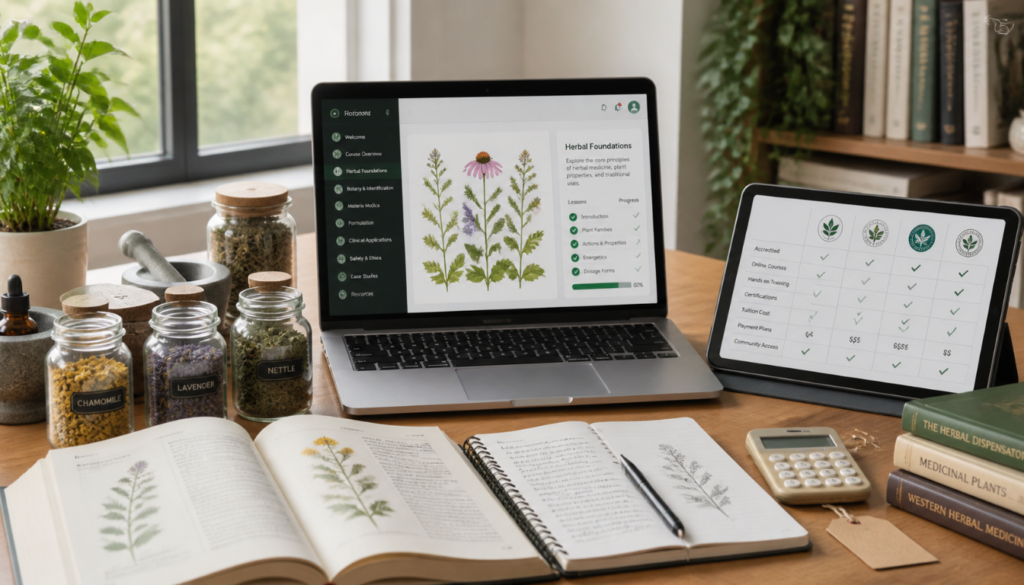
Salary in this field varies considerably depending on your career path, location, experience, and whether you are employed or self-employed. According to available data, the average herbalist salary in the United States sits between $55,000 and $65,000 per year. Entry-level roles start around $38,000, while experienced practitioners in high-demand specialisations can earn over $114,000.
Private practice clinical herbalists often out-earn those in employed roles, especially once they have an established client base. Herbalists who specialise in women’s health, sports nutrition, or paediatric herbalism, can typically charge more for their services. Location also plays a significant role, with urban areas and states with strong natural health cultures generally supporting higher rates.
For a full breakdown of salary data, factors affecting earning potential, and how to increase your income as an herbalist, see our dedicated article: How Much Do Herbalists Make? Salaries Explained.
How to Become a Herbalist: Routes Into the Field
There is no single official pathway into herbalism, and this is both a strength and a challenge of the profession. It means the field is accessible to people from many different backgrounds, but it also means that the quality and depth of training can vary enormously. Here are the main routes people take.
Herbalist Career: Formal Programmes
Formal herbal medicine programmes range from short certificate courses to full degree programmes. Certificate programmes typically cover foundational knowledge and can often be completed in six months to a year.
Diploma programmes offer more in-depth education over one to two years. Topics include botany, anatomy, physiology, biochemistry, materia medica, and clinical practice. Degree programmes, offered by universities such as Bastyr University and the National University of Natural Medicine, provide the most comprehensive academic training and are typically three to four years in length.
When choosing a programme, it is worth looking at whether the school has affiliations with recognised professional bodies such as the American Herbalists Guild, and whether the curriculum includes supervised clinical practice alongside academic study.
Apprenticeship and Mentorship
Apprenticeships and mentorships offer something that no classroom can fully replicate: hands-on, real-world experience working alongside an experienced practitioner. Many of the most skilled herbalists I know learned a significant part of their craft this way. Apprenticeships can be arranged through herbal schools or by approaching practising herbalists directly. They are particularly valuable for developing clinical skills, plant identification, and medicine-making techniques.
Self-Study
Self-directed learning has always been part of herbalism, and the wealth of resources available today makes it more viable than ever. Reading widely, attending workshops and conferences, experimenting with making your own preparations, and growing medicinal plants are all valuable parts of a herbalist’s education. Self-study works best when combined with formal training or mentorship rather than as a standalone route, particularly for those who want to work with clients.
Pursuing a Medical Degree
Some people interested in combining herbal medicine with conventional healthcare choose to pursue a medical or nursing degree and then incorporate herbal knowledge into their practice. Medical schools are increasingly offering courses in complementary and integrative medicine, and some qualified doctors and nurses go on to train formally in herbalism as a second qualification.
Types of Programmes: Certificate, Diploma, and Degree
Understanding the difference between programme types helps you make an informed choice about your training:
A certificate programme provides foundational knowledge in herbalism and is a good starting point for beginners or for those who want to use herbs in their personal or family life rather than professionally. Many certificate programmes can be completed entirely online and at your own pace.
A diploma programme offers a more substantial education and is generally more appropriate for those who want to work professionally in herbalism, whether in clinical practice, product making, or education. Diploma programmes usually require more hours of study and often include some form of supervised practice.
A degree programme is the most academically rigorous option and is suited to those who want to work in clinical or research settings or who want the credibility that comes with a university qualification. Degree programmes in herbal medicine are available in the UK, Australia, and at a small number of US universities.
Herbalist Career: The Truth About Herbalist Certification
One of the most common points of confusion for people entering this field is the question of certification. Here is what you actually need to know.
There is currently no federal licensing or certification requirement for herbalists in the United States. This means that technically anyone can call themselves an herbalist, which is why understanding what recognised credentials actually mean matters so much.
The most respected professional credential in North America is the Registered Herbalist (RH) designation offered by the American Herbalists Guild. This is not a certification in the formal sense, it is a professional membership. It is based on meeting suggested education guidelines (approximately 600 to 800 hours of herbal study) and completing around 400 hours of supervised clinical experience, followed by a peer-review process. This is the closest thing the profession has to a recognised standard of competence.
It is also worth being clear about the title “Master Herbalist.” Despite how it sounds, there is currently no certifying agency or licensing board that awards a recognised Master Herbalist qualification in the United States. Some schools use this title as a programme designation, but it is not a regulated or universally recognised credential. When you see it used, it refers to a school’s internal designation rather than an industry-wide standard.
In the UK, the National Institute of Medical Herbalists (NIMH) and the College of Practitioners of Phytotherapy both require degree-level study and supervised clinical training for full professional membership, making the UK framework somewhat more standardised than the US model.
Legalities: What You Need to Know
The legal landscape for herbalists in the United States is largely unregulated at the federal level, but this varies by state. In some states, practising herbalism without a healthcare licence may carry restrictions on what you can claim to do, particularly around diagnosing or treating specific medical conditions. It is important to research the regulations in your state before setting up a professional practice.
As a general principle, herbalists in the US are on solid ground when they describe their work as supporting health and wellbeing, providing educational information, and making general wellness recommendations. Crossing into diagnosing disease or claiming to treat specific medical conditions without a medical licence is where legal issues can arise.
Professional organisations such as the American Herbalists Guild publish guidance on the legal and ethical scope of practice for herbalists, and consulting these resources before starting a professional practice is strongly recommended.
Building Your Herbalist Career: How to Generate Income
One of the most practical questions I am asked is how herbalists actually make a living. Here are the main income streams available:
Client consultations are the primary income source for clinical herbalists. Rates vary depending on location and experience, but established practitioners typically charge between $75 and $200 per consultation.
Selling herbal products: tinctures, teas, salves, oils, and supplements can be a significant income stream, whether sold through your own website, at markets, or through retail partnerships.
Teaching workshops and classes: in person or online suits herbalists who enjoy education and can reach a wide audience beyond their local area.
Writing and content creation: books, articles, courses, and blog content can generate both direct income and indirect income by building your reputation and attracting clients.
Consulting for herbal product companies, natural health brands, or wellness businesses is another option, particularly for herbalists with specialist knowledge or clinical experience.
Most successful herbalists I know combine two or three of these income streams rather than relying on just one.
Resources to Get You Started
If you are at the beginning of your herbalist career journey, here are some practical starting points:
For education and training
- American Herbalists Guild – membership directory and education guidelines americanherbalistsguild.com
- Herbal Academy – accessible online courses at multiple levels: theherbalacademy.com
- American College of Healthcare Sciences – accredited online diploma and degree programmes
Sources and Furthure Reading
- Rosemary Gladstar’s Medicinal Herbs: A Beginner’s Guide
- The Earthwise Herbal by Matthew Wood
- The Herbal Medicine-Maker’s Handbook by James Green
- Medical Herbalism: The Science Principles and Practices Of Herbal Medicine
To start your home apothecary
Chamomile, echinacea, ginger, lavender, peppermint, and lemon balm are reliable, versatile, and widely available. These six herbs cover a broad range of everyday uses and will give you a solid practical foundation while you build your knowledge.
Before You Go – Herbalist Career
A herbalist career is not a conventional path, and that is precisely what makes it so rewarding. It demands genuine commitment to learning, not just at the beginning, but throughout your working life. The field is constantly evolving, new research emerges regularly, and the best practitioners I know are the ones who never stop being curious.
Whether you are drawn to clinical work, growing plants, making products, teaching, or writing, the most important thing is to start. Build your knowledge, find a mentor if you can, connect with the herbalist community, and let your particular strengths and interests guide the direction you take.
Enjoyed this article? Add theherbprof.com to your favourites and stay up to date with the latest herbal health guides and supplement reviews.
Sources and Further Reading – Herbalist Career
Little Herb Encyclopedia, by Jack Ritchason; N.D., Woodland Publishing Incorporated, 1995
The Ultimate Healing System, Course Manual, Copyright 1985, Don Lepore
Planetary Herbology, Michael Tierra, C.A., N.D., Lotus Press, 1988
Handbook of Medicinal Herbs, by James A. Duke, Pub. CRP Second Edition 2007
The Complete Medicinal Herbal, by Penelope Ody, Published by Dorling Kindersley
Related Articles
How Much Do Herbalists Make? Salaries Explained
Herbalist Meaning: Definition, Types and Natural Remedies
Herbalist Academy: Learn the Art of Herbal Medicine
Frequently Asked Questions – Herbalist Career
Is there a licence required to practise as a herbalist in the US?
There is no federal licence required to practise as a herbalist in the United States. However, regulations vary by state, and it is important to research what applies in your area. Professional organisations such as the American Herbalists Guild publish guidance on the legal scope of practice for herbalists.
What is the difference between a Registered Herbalist and a Certified Herbalist?
The Registered Herbalist (RH) designation from the American Herbalists Guild is the most recognised professional credential in North America. It is based on meeting education and clinical experience guidelines followed by peer review. There is no universally recognised “Certified Herbalist” qualification in the US, the title is used by some schools as an internal designation but does not represent an industry-wide standard.
What is a Master Herbalist?
Despite the impressive-sounding title, there is currently no certifying agency or licensing board that awards a recognised Master Herbalist qualification in the United States. Some schools use the term as a programme designation, but it is not a regulated credential. The AHG Registered Herbalist is a more meaningful and widely recognised professional standard.
How long does it take to become a herbalist?
It depends on the route you take. A certificate programme can be completed in six months to a year. A diploma typically takes one to two years. A degree programme takes three to four years. The AHG Registered Herbalist credential requires several hundred hours of study and clinical experience on top of formal training.
What is the job outlook for herbalists?
The demand for herbalists is growing steadily as more people seek natural and complementary approaches to health. The American Herbalists Guild notes that the field is expanding, driven by increasing public interest in plant medicine, integrative health, and preventative wellness. While the Bureau of Labor Statistics does not track herbalists as a specific category, the broader complementary health sector is on an upward trajectory.
Can herbalism be combined with another healthcare career?
Yes, and many practitioners do exactly this. Nurses, nutritionists, naturopaths, and other healthcare professionals regularly incorporate herbal knowledge into their existing practice. Some go on to train formally in clinical herbalism as a second qualification. This combination can be particularly powerful in integrative healthcare settings.
Please note: this article is for informational purposes only. If you are considering a professional practice in herbalism, always research the legal requirements in your country and state, and consult professional organisations for current guidance.