
The Herb Prof Team researches and writes our herbal guides, drawing on published research, traditional herbal references, and hands-on growing experience.
In this mugwort vs wormwood comparison, we look at two closely related herbs that serve very different purposes. Mugwort is the gentler of the two: used for digestion, menstrual support, and as a sleep and dream herb. Wormwood is far more potent and bitter, used for antiparasitic treatment and as the base of absinthe, but requires careful dosing due to its thujone content.
| Feature | Mugwort | Wormwood |
|---|---|---|
| Primary use | Digestion, menstrual support, lucid dreaming | Digestive bitters, antiparasitic, absinthe |
| Taste | Mildly bitter, slightly sweet | Intensely bitter |
| Safety | Safe in normal doses | Caution – toxic in high doses |
| Best taken as | Tea, tincture, moxibustion | Tincture, bitters, small doses only |
| Culinary use | Yes (mochi, teas, soups) | Limited (absinthe, vermouth only) |
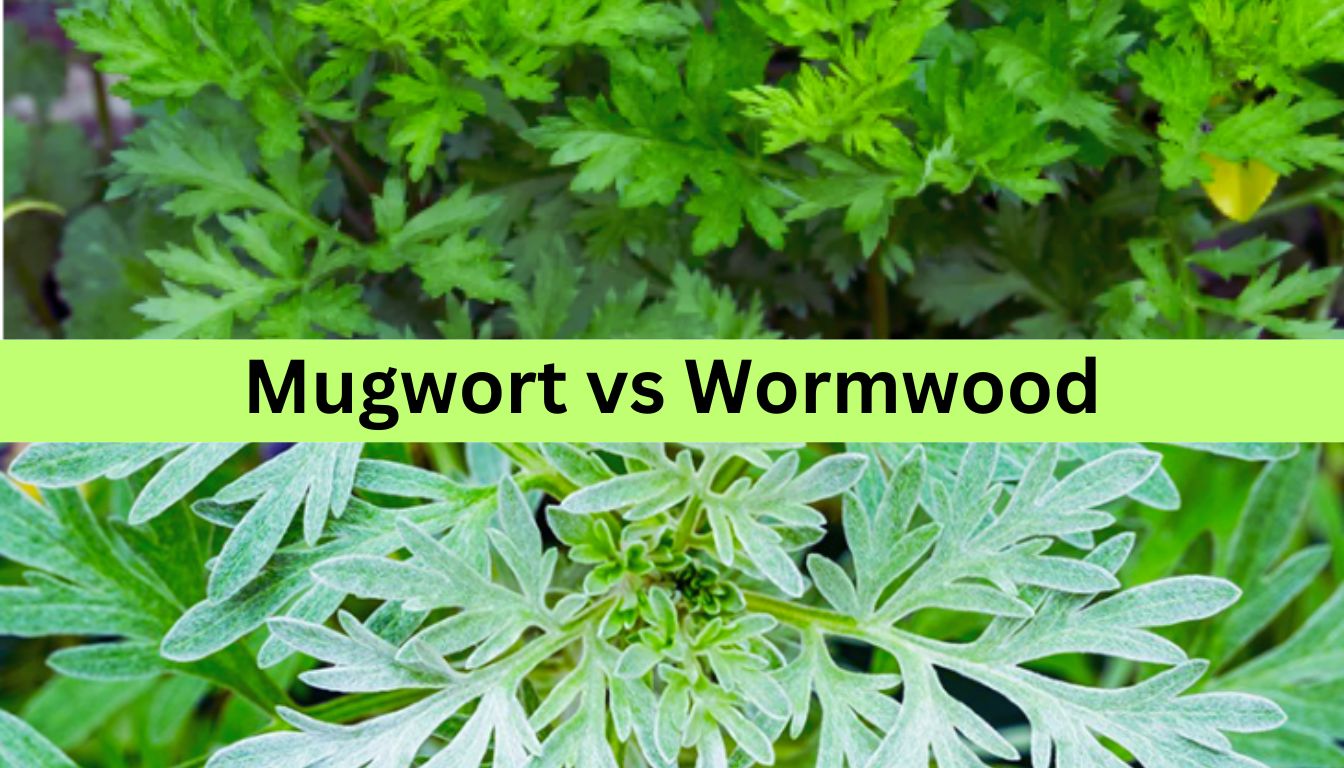
| Leaf colour | Green top, white underside | Silver-grey on both sides |
What Is the Difference Between Mugwort and Wormwood?
Mugwort and wormwood are two distinct species belonging to the same genus, Artemisia. Mugwort is scientifically known as Artemisia vulgaris, while wormwood is known as Artemisia absinthium. Although they share some similarities, several key differences set them apart.
Classification
Mugwort and wormwood both belong to the daisy family (Asteraceae) and are perennial herbs with a similar green shade. They differ in species, mugwort is classified as Artemisia vulgaris, while wormwood is Artemisia absinthium, a distinct species of the same genus.
Description
Mugwort is a tall plant that can grow up to six feet tall, while wormwood is smaller and typically reaches around three feet. Wormwood leaves are silver-grey on both sides, while mugwort has leaves that are green on top and white underneath. Mugwort plants may produce flowers in white, yellow, or red, while wormwood produces yellow flowers.
Uses
Mugwort has a long history of use in traditional medicine and is believed to have a variety of health benefits. It has traditionally been used to support digestion, ease menstrual cramps, and reduce anxiety. Mugwort also has a limited culinary role, mainly as a flavouring agent in certain dishes.
Wormwood is primarily known for its use in the production of absinthe, a highly alcoholic beverage. It is also used in vermouth and as a digestive tonic. Due to its intense bitterness and thujone content, it should only be consumed in small amounts.
Origin
Both mugwort and wormwood are native to Europe, Asia, and northern Africa. Mugwort is said to have originated in Europe and Asia, while wormwood is native to Europe and parts of Asia. Both plants have since been introduced to North America and are now found across much of the continent.
Mugwort vs Wormwood: Medicinal Uses
Both mugwort and wormwood have a deep-rooted history of use in traditional medicine.
Effects on Epilepsy and Other Health Benefits
Mugwort is traditionally believed to have anti-inflammatory and hepatoprotective properties that may help support liver health. In traditional Chinese medicine, it is used as a moxa, which involves burning dried mugwort to stimulate acupuncture points. Mugwort is also traditionally associated with lucid dreaming and has been used for this purpose across many cultures. Research published in PubMed confirms that Artemisia vulgaris extracts demonstrate antioxidant, hepatoprotective, antispasmolytic, antibacterial, and antifungal effects (Kowalski et al., 2020).
Wormwood has historically been used to address a range of health complaints, including epilepsy. It contains a compound called thujone, which is believed to be responsible for many of its medicinal properties. Thujone affects the central nervous system and was historically used in treatments for epilepsy, though this is no longer recommended.
Both herbs can cause side effects if misused, thujone in particular can be toxic in high doses. Always consult a healthcare professional before using either herb medicinally. A peer-reviewed study confirms that thujone in Artemisia absinthium exhibits neurotoxic properties above threshold concentrations, likely through GABA type A receptor modulation, reinforcing why careful dosing is essential (Lachenmeier & Uehleke, 2010).
Mugwort works best as a tincture. For practical use see our mugwort tincture recipe.
Mugwort vs Wormwood: Culinary Uses
Mugwort and wormwood both have culinary applications, but they serve very different roles in the kitchen and beyond.
A versatile culinary herb, mugwort is found in many cuisines around the world. In Japanese cuisine, its leaves are used to make mochi, a type of rice cake. It also flavours soups, stews, and teas. The essential oil is a popular addition to perfumes and aromatherapy blends.
Wormwood plays a narrower culinary role, best known as the key ingredient in absinthe, giving it its distinctive bitter flavour and green colour. It is also used in vermouth and has traditionally been used to stimulate appetite.
Both plants share a long history in traditional medicine, though their applications differ significantly. For a full breakdown of their medicinal properties, see the section above.
In terms of appearance, both plants have long, narrow leaves. Mugwort can grow up to six feet tall, while wormwood typically reaches around three feet.
Mugwort vs Wormwood: Identification Guide
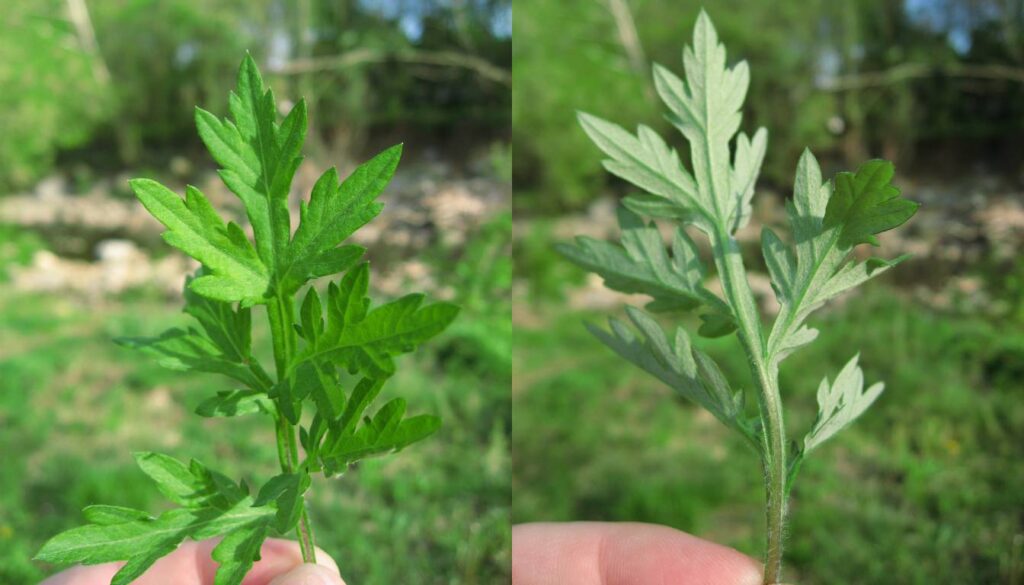
As both mugwort and wormwood belong to the same genus, Artemisia, they share many similarities in appearance, which can lead to confusion. Knowing how to tell them apart before using them for any purpose is essential.
Similarities in Appearance and Potential Risks of Misidentification
Mugwort and wormwood are both perennial herbs with a bitter taste and similar-looking flowers that bloom in late summer and early autumn. However, several features clearly set them apart.
Mugwort leaves are green on top and white underneath, with pointed tips and purplish stems. Wormwood leaves are silver-grey on both sides, more finely divided, and grey-green in colour. Their flowers also differ: mugwort produces small, reddish-brown flowers in clusters, while wormwood bears yellow-green flowers in small, ball-shaped clusters.
Misidentification carries real risks, as both plants contain compounds that may cause health problems if ingested in large quantities. Mugwort contains trace amounts of thujone, though at significantly lower levels than wormwood. Wormwood contains absinthin and thujone, which can cause hallucinations, seizures, and even death in large amounts. If you are unsure about the identity of a plant, consult a professional or avoid using it altogether.
Before You Go
Mugwort and wormwood are fascinating herbs, but they are not interchangeable. Mugwort is the gentler, more versatile choice for everyday herbal use: tea, tincture, or moxibustion. Wormwood is the more potent option, best reserved for specific purposes and always used in small, carefully measured doses.
If you are new to either herb, start with mugwort. It is safer, more forgiving, and has a wider range of traditional uses. If you want to explore wormwood, do so with guidance from a qualified herbalist and never exceed recommended doses.
Enjoyed this article? Add theherbprof.com to your favourites and stay up to date with the latest herbal health guides and supplement reviews!
References – Mugwort vs Wormwood
- Kowalski et al. (2020) – Artemisia vulgaris: Antioxidant and biological properties
- Lachenmeier & Uehleke (2010) – Thujone in Artemisia absinthium: Neurotoxic properties
Check the Following Articles
Catmint Vs Catnip: What’s the Difference?
Chamomile vs Daisy: Key Differences You Need to Know
Tulsi Vs Basil: Differences and Similarities
Frequently Asked Questions – Mugwort vs Wormwood
What are the distinguishing characteristics between mugwort and wormwood?
Mugwort and wormwood are two closely related plants that share many similarities. They both belong to the Artemisia genus, but their foliage differs noticeably, mugwort leaves are green on top with a white underside, while wormwood leaves are silver-grey on both sides. Mugwort usually grows larger than wormwood and has uniquely pointed leaves, while wormwood has more finely divided, grey-green leaves. Additionally, mugwort has a sweet, herbal aroma, while wormwood has a bitter, medicinal scent.
Can mugwort tea be used for medicinal purposes and if so, what are its benefits?
Mugwort tea has been used for centuries in traditional medicine for a variety of purposes. It is traditionally believed to support digestion, ease anxiety, and help regulate irregular periods, and may also have anti-inflammatory, antifungal, and antibacterial properties. However, more research is needed to confirm these benefits, and mugwort should not be used as a substitute for professional medical advice.
Is smoking mugwort safe, and what effects does it have?
Smoking mugwort is not recommended, as it can be harmful to the lungs and may cause respiratory issues. Additionally, the effects of smoking mugwort are not well understood, and it is not recommended as a substitute for professional medical treatment.
How does wormwood interact with the human body, and what are its uses?
Wormwood has a long history of use in traditional medicine, where it was valued for its antiseptic, antifungal, and antibacterial properties. It has traditionally been used to support digestion and stimulate appetite. However, wormwood should be used with caution, as it contains thujone, a toxic compound that can cause seizures and other adverse effects in high doses.
What are the differences between sweet wormwood and common wormwood?
Sweet wormwood, also known as Artemisia annua, is a different species of wormwood than common wormwood, which is also known as Artemisia absinthium. Sweet wormwood has traditionally been used in Chinese medicine to help manage fever and malaria symptoms.
Can mugwort be used as a natural remedy for parasites?
There is some preliminary evidence that mugwort contains compounds with mild antiparasitic activity. However, wormwood is significantly better studied for this purpose, it contains absinthin and thujone, which have demonstrated activity against intestinal parasites in traditional medicine. If antiparasitic treatment is your goal, wormwood is the more appropriate choice between the two. Always consult a qualified herbalist before use.