
The Herb Prof Team researches and writes our herbal guides, drawing on published research, traditional herbal references, and hands-on growing experience.
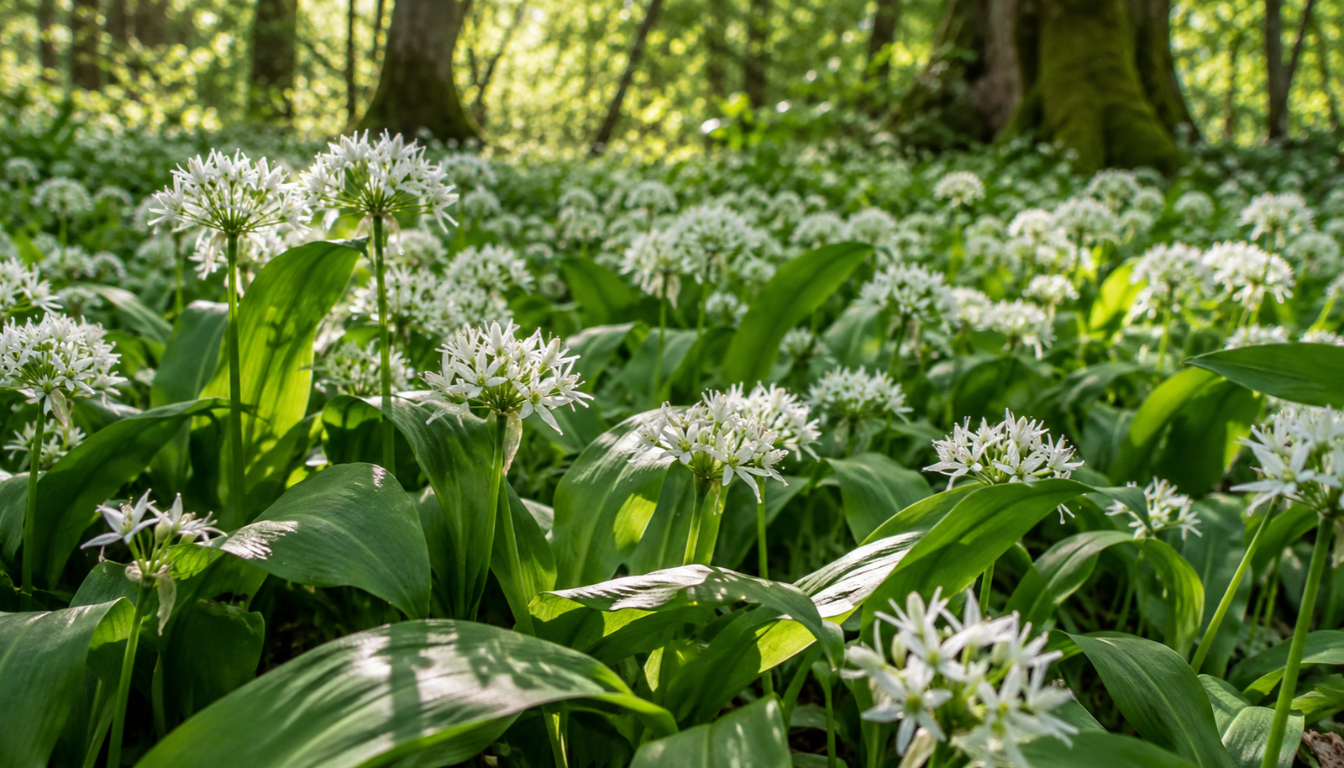
Wild garlic (Allium ursinum) carpets damp woodland in spring, and its soft green leaves make a mild, fresh-tasting alternative to bulb garlic. It is a rewarding plant to forage, but it has poisonous look-alikes, so correct identification comes first. This guide shows you how to identify wild garlic safely, harvest it sustainably, and cook with it.
This article is for general information only. If you are not completely sure a plant is wild garlic, do not eat it.
Foraging Wild Garlic: An Overview
Wild garlic grows in damp, shaded places such as deciduous woods and stream banks, where it often forms large patches. The leaves are best picked in early spring, before the flowers open, because they are tender and mild at that stage. Wild garlic is milder than bulb garlic, but it still adds a clear garlic flavor to salads, soups and sauces.
How to Identify Wild Garlic
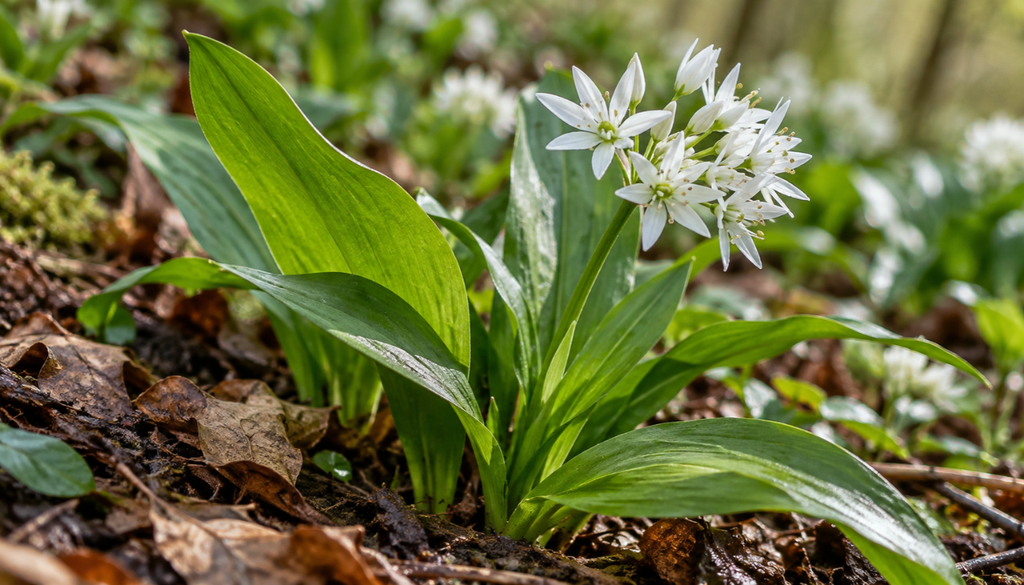
Wild garlic has long, pointed, oval leaves with smooth edges that grow up from the base of the plant. Between April and June it produces rounded clusters of small white, star-shaped flowers on leafless stalks. Crushed leaves smell strongly of garlic, and the plant can reach about 14 inches (35 cm) tall.
Poisonous Look-Alikes
Several poisonous plants grow in the same kinds of places and can look similar to wild garlic, especially when they are young and not in flower.
- Lily of the valley is the best-known look-alike and is highly poisonous. Its flowers are white bells, not stars, and it does not smell of garlic.
- Lords-and-ladies (Arum maculatum) and autumn crocus (meadow saffron) are also poisonous and are sometimes mistaken for wild garlic.
Smell alone is not a safe test. The garlic scent can rub off on your fingers and onto look-alike leaves, so a plant that smells of garlic after you have handled wild garlic may not be wild garlic. Instead, check every leaf you pick. Crush each one, confirm the garlic smell on that leaf, and check that it matches the leaf shape described above.
If you are new to foraging, go with an experienced forager or use a trusted local field guide before eating anything you find. If you are not completely sure, do not eat it.
Harvesting Wild Garlic
Spring is the best time to harvest, because the leaves are fresh and flavorful. To keep patches healthy for years, harvest with care.
- Pick only a few leaves from each plant. This leaves enough for the plant to keep growing.
- Leave the bulbs in the ground. Taking the leaves is enough for cooking.
- Avoid roadsides and busy paths. Plants near roads can pick up fumes and dirt, and walked-on areas may be contaminated.
- Move on from picked-over areas. If a patch looks thin, choose another one.
- Leave plenty behind. That way the wild garlic can flourish for other people and for wildlife.
- Only pick where you are allowed to. If the land is private, ask the owner first.
Wash the leaves thoroughly before you use them.
Delicious Recipes
Wild garlic cooks quickly, so add it near the end of cooking if you want to keep the fresh flavor. Here are three simple recipes.
Fresh Pesto
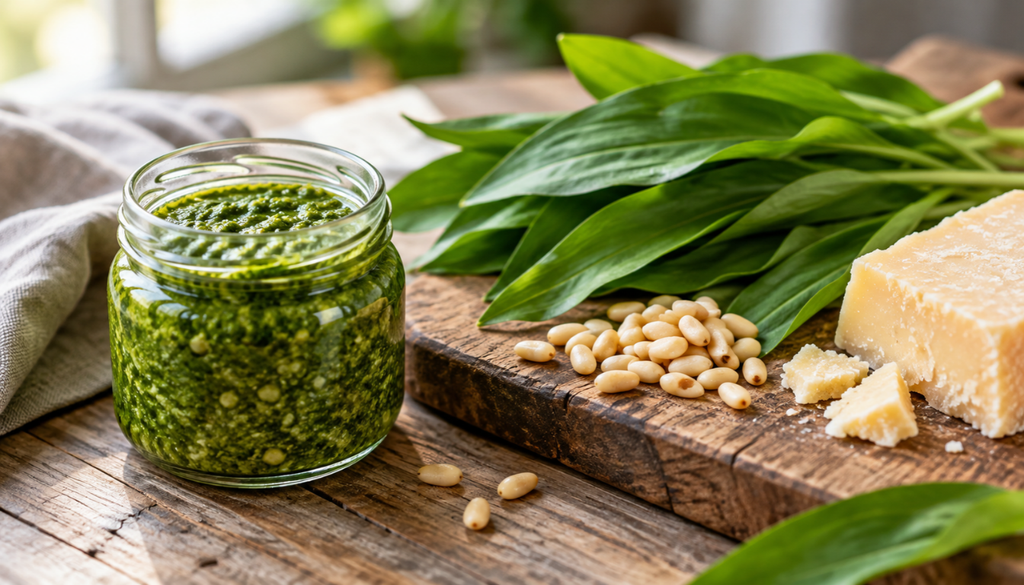
- First, wash and dry 1 cup of fresh wild garlic leaves.
- Next, add them to a food processor with a handful of pine nuts or walnuts, ½ cup of grated Parmesan cheese and a pinch of salt.
- Then drizzle in olive oil while blending until smooth.
Use the pesto on pasta, sandwiches or as a dip. Because it contains fresh garlic in oil, keep it in the fridge and use it within a few days. For longer storage, freeze it in small portions.
Wild Garlic Soup
- Melt 1 tablespoon of butter in a pot over medium heat.
- Add 1 chopped onion and cook until soft.
- Pour in 4 cups of vegetable stock and bring to a simmer.
- Then add about 2 cups of washed wild garlic leaves and cook for 5 minutes.
- Finally, blend until creamy and season with salt and pepper. Serve with a swirl of cream or yogurt.
Wild Garlic Butter
- Soften ½ cup of unsalted butter at room temperature.
- Finely chop a handful of wild garlic leaves and mix them into the butter with a pinch of salt.
- Roll the butter into a log in parchment paper and chill until firm.
Slice pieces off to top grilled meat, vegetables or warm bread. Keep the log in the fridge and use it within a few days, or freeze it for longer storage.
Before You Go – Wild Garlic Guide
Wild garlic is one of the easiest spring ingredients to cook with, as long as you identify it carefully and pick sparingly. Use the recipes above as a starting point, and leave plenty of plants behind so the patch returns next year.
References – Wild Garlic Guide
Little Herb Encyclopedia, by Jack Ritchason; N.D., Woodland Publishing Incorporated, 1995
The Ultimate Healing System, Course Manual, Copyright 1985, Don Lepore
Planetary Herbology, Michael Tierra, C.A., N.D., Lotus Press, 1988
Handbook of Medicinal Herbs, by James A. Duke, Pub. CRP Second Edition 2007
The Complete Medicinal Herbal, by Penelope Ody, Published by Dorling Kindersley
Sources
- Woodland Trust. Wild garlic (Allium ursinum).
- Woodland Trust. Lily-of-the-valley (Convallaria majalis).
- The Wildlife Trusts. Wild garlic.
- Oregon State University Extension. Herbs and vegetables in oil (for the pesto storage advice).
Related Articles
Revitalize Your Mornings: Herbal Rituals to Boost Your Day
Grow Echinacea from Seed to Bloom: A Step-by-Step Guide
Skullcap or Blue Vervain: Which Herb Brings More Calm?
Frequently Asked Questions – Wild Garlic Guide
What is wild garlic?
Wild garlic, also called ramsons (Allium ursinum), is a woodland plant with broad green leaves, white star-shaped flowers and a strong garlic smell.
How can I identify wild garlic?
Look for long, pointed leaves growing from the base of the plant, a strong garlic smell when a leaf is crushed, and clusters of star-shaped white flowers in spring. Check every leaf, because poisonous look-alikes such as lily of the valley can grow nearby.
When is the best time to forage for wild garlic?
Early spring, before the flowers open, when the leaves are tender and mild.
What are sustainable foraging practices for wild garlic?
Take only a few leaves from each plant, leave the bulbs in the ground, avoid roadsides, and move on from patches that are thin.
Can beginners forage for wild garlic?
Beginners should forage with an experienced forager or use a trusted field guide first. If you are not completely sure of a plant, do not eat it.
How can I use wild garlic in my cooking?
Add the leaves to salads, soups, pesto and butter, or use them in place of spinach or garlic in many dishes.
I have Congestive heart disease. I had heard about garlic being good for you especially aged. My wife had dug up a little wild garlic while planting. Out of curiosity l wiped of dirt and husk and ate. l would almost swear it made me feel better. Are the chemicals in the wild garlic same as regular garlic. The one I am speaking of produces cluster of small flowers that turn into seed size sets
Garlic is a wonderful plant, and wild garlic is very interesting too. In general, wild garlic and regular cultivated garlic are related, since they are both in the Allium family. They do share some similar sulfur-containing compounds, which are what give garlic and onion plants their strong smell and many of their traditional properties.
That said, they are not exactly the same plant, and the strength and chemical makeup can vary depending on the species, the part of the plant used, the growing conditions, and whether it is fresh, cooked, dried, or aged. Aged garlic supplements are also different from simply eating a fresh wild garlic bulb.
From your description, clusters of small flowers that turn into little seed-like sets, it may be a type of wild garlic or wild onion that produces small aerial bulbils. However, I would be careful with identification. The article I wrote discusses wild garlic as Allium ursinum, but the name “wild garlic” can refer to several different Allium species. I cannot positively identify the plant without seeing it.
A good rule with wild Alliums is that the leaves and bulb should smell clearly like garlic or onion when crushed. Still, I would not eat more unless you are completely certain of the identification and know the area has not been sprayed or contaminated. Some poisonous plants can be mistaken for edible wild plants, so careful identification is very important.
Because you have congestive heart disease, I would be especially cautious about using garlic or wild garlic medicinally. Garlic may be healthy as a food for many people, but in larger or supplemental amounts it can affect bleeding risk and may interact with medications, especially blood thinners, aspirin, heart medications, blood pressure medication, or anything your cardiologist has prescribed.
So my opinion would be: properly identified wild garlic may be fine as a small culinary food, but I would not use it as a treatment or take it regularly in medicinal amounts without asking your doctor, cardiologist, or pharmacist first. Please also do not change or stop any heart medication because something natural seems to make you feel better.
I’m glad it seemed to help you, but with heart conditions it is always best to be cautious. If you ever have chest pain, worsening shortness of breath, swelling, dizziness, or sudden weakness, that would be a reason to seek medical care right away.