
The Herb Prof Team researches and writes our herbal guides, drawing on published research, traditional herbal references, and hands-on growing experience.
Finding the best Rhodiola rosea supplement is not as straightforward as it looks. The market for the best Rhodiola rosea supplement is crowded, the quality varies enormously, and most product pages tell you very little about what actually matters. Rhodiola rosea has been used for centuries to fight fatigue, sharpen the mind, and build resilience under stress, but only a well-standardised extract will deliver those benefits reliably.
In this guide I review the five best Rhodiola rosea supplements available right now, explain what the science actually says, and give you the practical information you need to choose the right product and dose for your situation.
What Is Rhodiola Rosea?
Rhodiola rosea (Rhodiola rosea L., family Crassulaceae) is a flowering perennial native to the cold mountainous regions of Siberia, Scandinavia, and Central Asia, where it has been used for centuries to build physical endurance, sharpen mental performance, and strengthen resistance to stress. In traditional Siberian medicine it was given to soldiers and workers before demanding expeditions. In Scandinavia it appeared in the Flora Danica pharmacopoeia as early as 1755.
The plant’s medicinal activity centres on two primary groups of active compounds: rosavins (rosavin, rosin, rosarin) and salidroside (also called tyrosol glycoside). These compounds work synergistically to modulate the hypothalamic-pituitary-adrenal (HPA) axis, the system that governs your cortisol stress response. Salidroside in particular has been shown to regulate HPA axis activity by reducing corticotropin-releasing hormone (CRH) expression in the hypothalamus and normalising elevated corticosterone levels, which is why Rhodiola has a calming, steadying effect under chronic stress rather than a sedative one.
The European Medicines Agency (EMA) classifies Rhodiola rosea root as a traditional herbal medicinal product for the temporary relief of stress-related symptoms such as fatigue and weakness. This classification carries genuine regulatory weight and distinguishes it from less well-evidenced adaptogens.
In clinical practice, I use Rhodiola primarily for patients experiencing burnout, cognitive fatigue, and stress-related exhaustion. It is one of the few adaptogens where the mechanistic research and the clinical outcomes align closely enough that I feel confident recommending specific products at specific doses.
What the Evidence Says
I want to be upfront with you here: Rhodiola rosea is one of the better-researched adaptogens, but the evidence is not yet at the level of a pharmaceutical drug. What we have is genuinely promising, and in several areas, convincing enough for me to recommend it in practice. It deserves an honest read.
Where the evidence is strong:
The most robust clinical signal is for stress-related fatigue. A randomised, double-blind, placebo-controlled trial published in Planta Medica found that the standardised extract SHR-5 significantly reduced symptoms of fatigue and improved mental performance in individuals suffering from stress-related burnout over an eight-week period.
A separate multi-centre open-label trial specifically in burnout patients showed meaningful reductions in fatigue, exhaustion, and impaired concentration after 12 weeks of Rhodiola rosea treatment. These are the patient groups I see most in clinic, and the outcomes in studies mirror what I observe.
Where the picture is more nuanced:
Rhodiola has also been studied for physical performance, depression, and cognitive enhancement. The results are mixed. A 2012 systematic review found that while some trials point to real benefit for mental and physical fatigue, the conclusions remain limited. Small sample sizes, inconsistent extract quality, and studies that simply did not run long enough all make it difficult to draw firm conclusions.
A notable 2014 RCT in nursing students on shift work found no advantage over placebo for fatigue reduction, and in some measures placebo performed better. I cite this study deliberately because I think it matters: Rhodiola is not a cure-all, and it does not work equally well for everyone. Which brings us to finding the best Rhodiola rosea supplement for your needs.
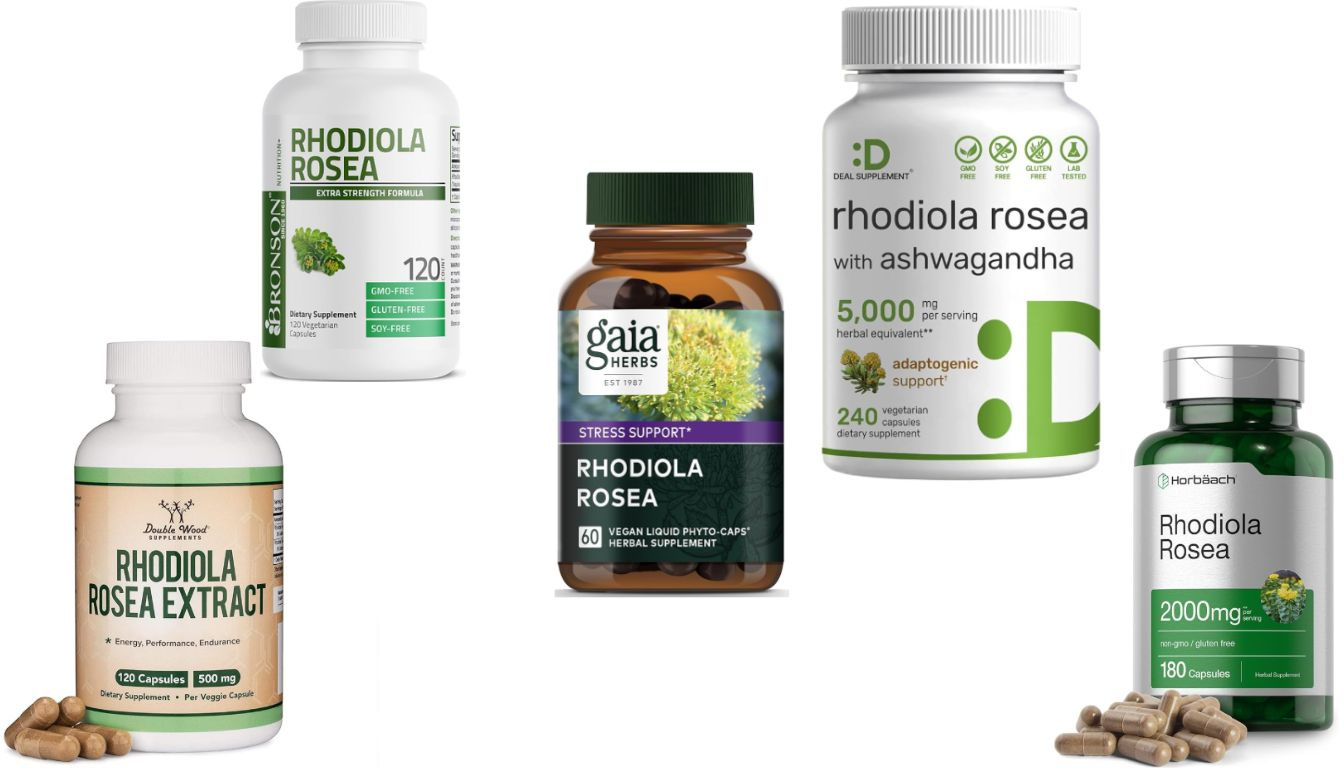
The 5 Best Rhodiola Rosea Supplements
With that in mind, here is my pick of the best Rhodiola rosea supplement for every type of patient.
| Product | Dose | Standardisation | Best For |
|---|---|---|---|
| Double Wood | 500mg | 3% rosavins / 1% salidroside | First-time users, consistency |
| Bronson | 1000mg | 3% rosavins | Higher therapeutic dose |
| Gaia Herbs | Liquid extract | Organic, full spectrum | Sensitive patients, bioavailability |
| DEAL SUPPLEMENT | Blend | Rhodiola + Ashwagandha | Maintenance, budget dual protocol |
| Horbaach | 1000mg | 3% rosavins | Budget entry point |
Double Wood Rhodiola Rosea – Best for Standardisation
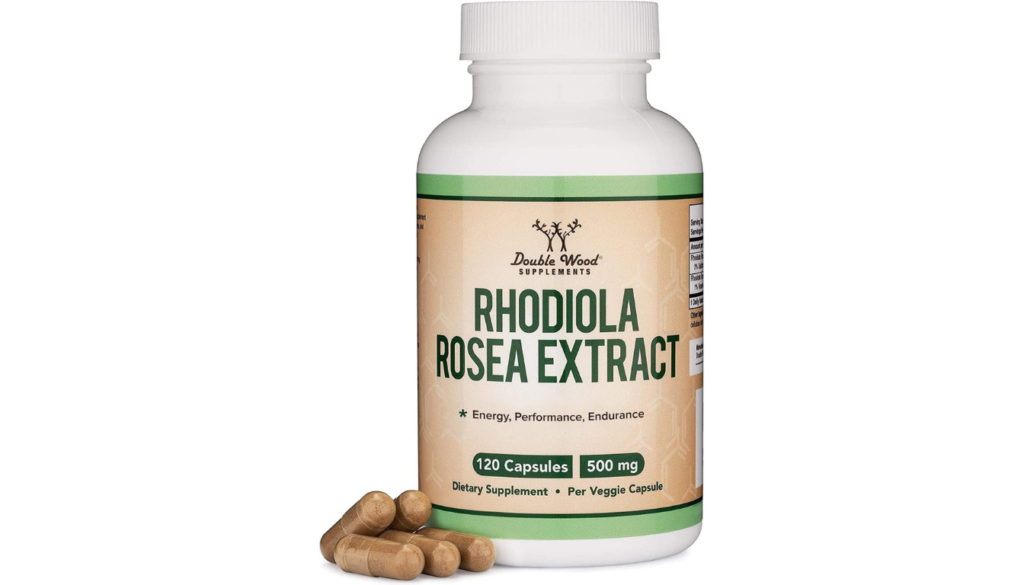
When I recommend Rhodiola to a patient for the first time, Double Wood is usually where I start. The reason is simple: consistency. Each capsule delivers 500mg of Rhodiola rosea root extract standardised to 3% rosavins and 1% salidroside, the exact ratio used in the majority of clinical trials, and the benchmark I look for on any label.
Pros:
- Standardised to 3% rosavins / 1% salidroside – clinically relevant ratio
- 500mg per capsule, 60 capsules per bottle – a solid two-month supply at a maintenance dose
- Third-party tested, manufactured in a GMP-certified facility in the USA
Cons:
- Contains rice flour as a filler – not ideal for patients with sensitive digestion
- Only one capsule size – no lower-dose option for patients I want to start at 250mg
I have recommended Double Wood to patients dealing with burnout and stress-related cognitive fatigue for several years now, and the feedback has been consistently positive. What I appreciate most as a practitioner is that I know exactly what my patients are getting with every bottle. There is no guessing about extract concentration or batch-to-batch variation, which is unfortunately common in the supplement industry.
It is not the cheapest option on this list, but in my experience the cost difference between a well-standardised extract and a poorly standardised one is not worth the saving. If Rhodiola is going to work for your patient, or for you, the active compounds need to be present in meaningful quantities. For most people starting out, this is simply the best Rhodiola rosea supplement on the market right now.
If you want to give it a try, you can check the current price on Amazon here.
Bronson Rhodiola Boost – Best for Dose Flexibility
Bronson is a brand I have a lot of respect for. They have been manufacturing supplements since 1960, and that longevity in an industry full of fly-by-night operations tells you something. Their Rhodiola Boost stands out on this list primarily because it offers 1000mg of Rhodiola rosea root extract per serving. That is the highest dose of any product here, and it makes it particularly useful for patients where I want to push closer to the upper end of the clinical dosing range.
Pros:
- 1000mg per serving, useful for patients requiring a higher therapeutic dose
- Standardised to 3% rosavins, in line with clinical trial specifications
- Excellent value per milligram compared to most competitors
Cons:
- Higher dose makes it less suitable as a starting point for sensitive patients or those new to adaptogens
- Capsule size is large, which some patients find difficult to swallow
In practice I tend to reach for Bronson when a patient has already responded well to a lower-dose Rhodiola product and I want to step up the therapeutic effect. It is also the product I most commonly suggest for patients managing significant occupational stress or heavy physical training loads.
One thing worth noting: more is not always better with Rhodiola. At doses above 600mg, some patients report mild overstimulation or disrupted sleep if taken too late in the day. I always advise starting lower and titrating up, and Bronson works best when used with that approach in mind.
If you want to give it a try, you can check the current price on Amazon here.
Gaia Herbs Rhodiola – Best Liquid Capsule Option
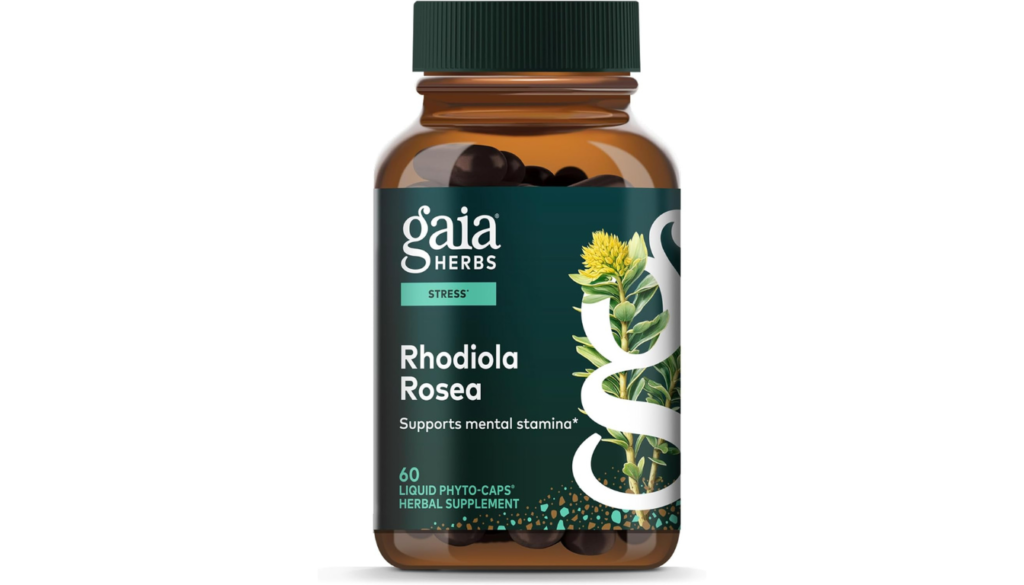
Gaia Herbs is one of the few supplement companies I trust without hesitation. They grow a significant proportion of their own herbs on a certified organic farm in North Carolina, and every product carries a “Meet Your Herbs” traceability code that lets you verify the exact origin and testing results of your batch. That level of transparency is rare in this industry, and it matters.
Pros:
- Phyto-Caps format delivers a concentrated liquid extract rather than a dry powder
- Certified organic, non-GMO, and free from common fillers and additives
- Full traceability from seed to shelf via Gaia’s own verification system
Cons:
- Lower standardised rosavin content than Double Wood or Bronson
- More expensive per serving than most other options on this list
The liquid Phyto-Cap format is something I find genuinely useful in clinic. Liquid extracts are absorbed more readily than compressed powders, which means the active compounds reach the bloodstream faster. For patients with digestive issues or those who absorb nutrients poorly, this format can make a real difference to outcomes.
Where I reach for Gaia is with patients who are particularly sensitive to additives and fillers, or those who prioritise organic certification. It is not the product I choose when I need a precisely standardised dose. But when clean ingredients and bioavailability are the priority, Gaia is my first recommendation.
If you want to give it a try, you can check the current price on Amazon here.
DEAL SUPPLEMENT Rhodiola + Ashwagandha – Best Value Adaptogen Blend
This is the product I recommend most often to patients who ask me about adaptogens but are working with a limited budget. DEAL SUPPLEMENT offers a combination of Rhodiola rosea and Ashwagandha in a single capsule, at a price per serving that is hard to argue with. For patients who would benefit from both herbs, it removes the need to buy two separate products.
Pros:
- Combines Rhodiola rosea and Ashwagandha in one capsule, good value for a dual adaptogen protocol
- Large bottle size gives an extended supply at a low monthly cost
- Suitable for patients dealing with both fatigue and anxiety, where both herbs are clinically relevant
Cons:
- Individual doses of each herb are lower than you would get in a single-herb product
- Not ideal for patients who need a therapeutic dose of Rhodiola specifically
I do want to be honest about the trade-off here. When you combine two herbs in one capsule, something has to give on dose. If a patient needs 400 to 600mg of Rhodiola daily for stress-related fatigue, this blend will not deliver that on its own. I think of it more as a maintenance product than a therapeutic one.
That said, for patients who are generally well but want broad adaptogenic support as part of a daily wellness routine, this combination makes good sense. Rhodiola covers the energy and cognitive side while Ashwagandha brings a calming, cortisol-modulating balance. The two herbs complement each other well, and at this price point the blend is genuinely good value.
If you want to give it a try, you can check the current price on Amazon here.
Horbaach Golden Root – Best Budget Pick
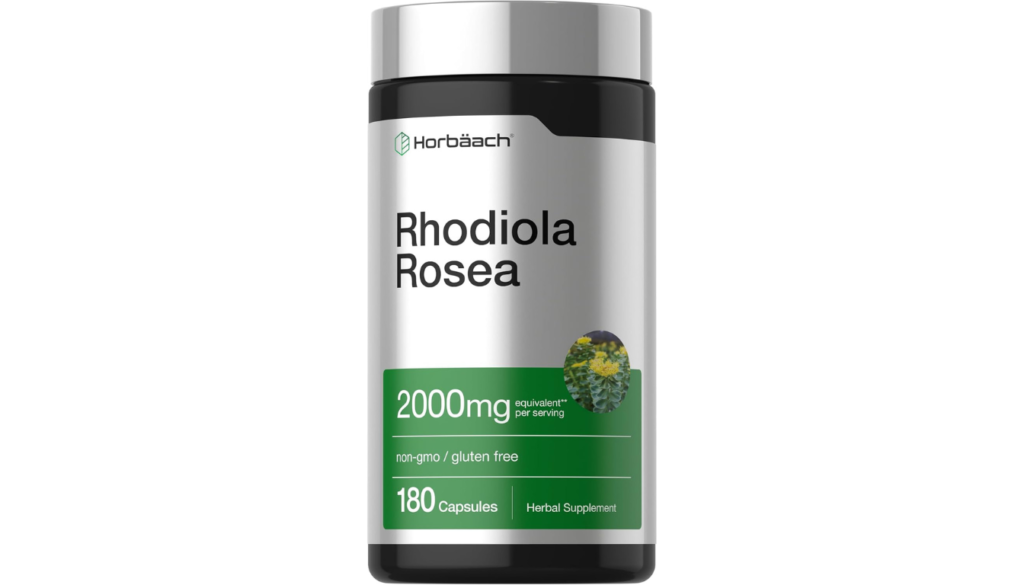
Not every patient I see can spend a lot on supplements. That is the reality of clinical practice, and I think it is important to have a genuinely good budget option I can recommend without compromising on the basics. Horbaach Golden Root is that option. It delivers 1000mg of Rhodiola rosea root extract per serving, standardised to 3% rosavins, at a price per capsule that is among the lowest on the market.
Pros:
- 1000mg per serving standardised to 3% rosavins at an entry-level price point
- 180 capsules per bottle, giving exceptional value for long-term use
- Non-GMO, gluten free, and free from artificial additives
Cons:
- No third-party testing certification listed, which I always consider a limitation
- Brand transparency is lower than Gaia or Double Wood
I want to be clear about what “budget pick” means here. It does not mean a poor product. Horbaach has a solid manufacturing record and their standardisation figures are consistent with what you would expect from a reputable extract. What it lacks is the independent verification and brand transparency that the premium options offer.
For a patient who is price-sensitive and simply wants to try Rhodiola for the first time, Horbaach is a sensible starting point. If they respond well and want to commit to longer-term use, I would then consider stepping them up to Double Wood or Gaia depending on their priorities. Think of it as a low-risk entry point into Rhodiola supplementation rather than a permanent solution.
If you want to give it a try, you can check the current price on Amazon here.
What to Look for When Buying Rhodiola Rosea
Walking into a health food shop or searching online for Rhodiola rosea can be overwhelming. There are hundreds of products, and most of them look identical on the surface. After years of recommending it in clinical practice, choosing the best Rhodiola rosea supplement comes down to five criteria I apply to every product I assess.
Standardisation is non-negotiable
This is the single most important factor. A Rhodiola supplement is only as good as its active compound content. I only recommend products standardised to a minimum of 3% rosavins and 1% salidroside. These are the ratios used in the clinical trials that produced positive results, and without them you have no way of knowing whether the product contains a therapeutic dose of anything meaningful. If the label does not state the standardisation percentage, put it down and walk away.
Extraction method matters
Quality Rhodiola extracts use either water, ethanol, or a combination of both as the extraction solvent. Ethanolic extraction tends to yield higher rosavin concentrations, while water extraction preserves more salidroside. The best products use a dual extraction process to capture the full spectrum of active compounds. This information is not always on the label, but reputable brands will publish it in their product documentation or on request.
Dose range to look for
Clinical trials have used doses ranging from 200mg to 600mg of standardised extract daily. I generally start new patients at 200 to 300mg and assess tolerance before increasing. Products offering 400 to 500mg per capsule give useful flexibility. Anything above 600mg daily should only be considered under practitioner guidance.
Third-party testing
Independent testing by organisations such as NSF International, USP, or Informed Sport verifies that what is on the label is actually in the capsule. It also screens for contaminants including heavy metals and pesticide residues. I consider third-party certification a strong positive signal, though its absence does not automatically disqualify a product if the brand has a strong transparency track record.
Form: capsules vs liquid extract
Capsules filled with dry powder are the most common format and perfectly adequate for most patients. Liquid extracts and liquid-filled capsules like Gaia’s Phyto-Caps offer faster absorption and are worth considering for patients with digestive issues or poor nutrient absorption. Tinctures are also available but make precise dosing harder to control.
Dosage and How to Take It
One of the most common questions I get from patients is not whether Rhodiola works, but how to take it correctly. Dose, timing, and cycling all affect how well this herb performs, and getting them right makes a significant difference to outcomes.
How much to take
The clinical evidence centres on a dosage range of 200mg to 600mg of standardised extract daily. I start most new patients at 200 to 300mg and hold that dose for two to three weeks before considering an increase. This allows the body to adjust and gives me a clear picture of individual tolerance. Most patients find their optimal dose sits between 300mg and 400mg daily.
When to take it
Timing matters more with Rhodiola than with most other adaptogens. It has a mildly stimulating effect on the central nervous system, which means taking it too late in the day can interfere with sleep. I advise patients to take it first thing in the morning, ideally 20 to 30 minutes before breakfast. If a second dose is needed, it should be taken no later than early afternoon.
With or without food
Rhodiola is generally well tolerated on an empty stomach, and some evidence suggests absorption may be slightly better when taken before eating. That said, patients with sensitive stomachs can take it with a light meal without significantly affecting its efficacy.
Cycling
This is something I feel strongly about. Rhodiola is an adaptogen, not a daily supplement to take indefinitely without pause. I recommend a cycle of six weeks on followed by one to two weeks off. This prevents tolerance build-up and keeps the herb working effectively over the long term. After the break, most patients notice a renewed response when they restart.
Side Effects and Who Should Avoid It
Rhodiola rosea has a good safety profile overall, and serious adverse effects are rare in the clinical literature. That said, I always make sure patients have a clear picture of what to watch for and when to avoid it entirely.
Common side effects
At standard doses, most patients tolerate Rhodiola very well. The side effects I see most often in practice are mild and tend to resolve within the first week or two as the body adjusts. These include dizziness, dry mouth, and occasional headaches. At higher doses, some patients experience a feeling of overstimulation or restlessness. Disrupted sleep is also possible if the herb is taken too late in the day, which is why timing matters as much as dose.
Who should avoid it
I do not recommend Rhodiola rosea to the following groups:
- Pregnant or breastfeeding women, as safety data in these populations is insufficient
- Patients with bipolar disorder, as its stimulating properties may trigger hypomanic episodes
- Children and adolescents, where there is no adequate safety data to guide dosing
Drug interactions to be aware of
This is the area I am most cautious about in clinical practice. Rhodiola rosea has known interactions with several medication classes that require careful consideration.
- Antidepressants, particularly MAOIs and SSRIs, where combined use carries a risk of tachyarrhythmia and serotonin-related effects
- Anticoagulants such as warfarin, where Rhodiola may affect clotting parameters
- Antidiabetic medications, as Rhodiola may have additive blood sugar lowering effects
- Blood pressure medications, where combined use may produce an excessive hypotensive effect
If any of your patients are on prescription medication, I would always recommend checking for interactions with a qualified practitioner before starting Rhodiola. This is not a herb to combine with medication casually.
Rhodiola vs Ashwagandha
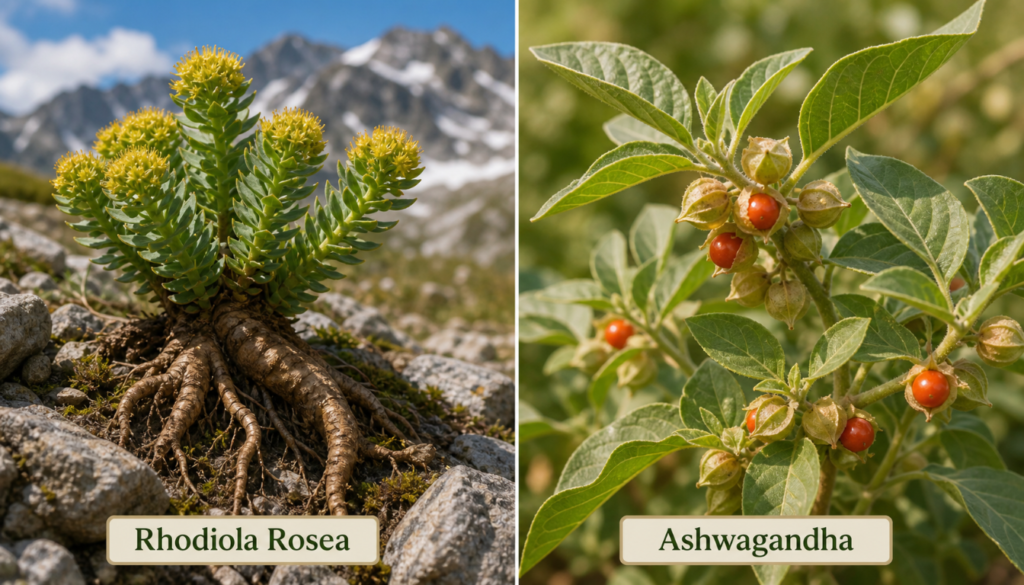
This is the question I get asked more than any other when it comes to adaptogens. Both herbs are well researched, both support the body’s stress response, and both have a legitimate place in clinical practice. But they work differently, and choosing the wrong one for the wrong patient produces disappointing results. If stress and fatigue are your primary concern, the best Rhodiola rosea supplement will almost always serve you better than Ashwagandha alone.
The simplest way I explain it to patients is this. Rhodiola is energising and Ashwagandha is calming. They act on the same stress system but from opposite directions, which is why some practitioners, myself included, use them together in certain cases.
How They Compare
| Criteria | Rhodiola Rosea | Ashwagandha |
|---|---|---|
| Primary action | Stimulating, energising | Calming, sedating |
| Best time to take | Morning | Evening |
| Best for | Mental fatigue, burnout, cognitive performance | Anxiety, poor sleep, chronic stress |
| Mechanism | HPA axis modulation, ROS scavenging | Cortisol reduction, GABA modulation |
| Evidence base | Strong for fatigue and stress | Strong for anxiety and sleep |
| Who I recommend it to | Patients who are exhausted but wired | Patients who are anxious and unable to switch off |
| Can they be combined? | Yes, with care | Yes, with care |
The patient who needs Rhodiola is typically someone who wakes up tired, struggles to concentrate during the day, and feels mentally flat despite adequate sleep. The patient who needs Ashwagandha is more often someone who feels wound up, has difficulty relaxing, and finds their mind racing at night.
Where I use both together is in patients presenting with full burnout, exhausted but simultaneously unable to switch off. In that case, Rhodiola in the morning and Ashwagandha in the evening can be a very effective combination. The DEAL SUPPLEMENT blend on this list takes a similar approach, though at lower individual doses than I would use therapeutically.
Before You Go – Best Rhodiola Rosea Supplement
Rhodiola rosea is one of those herbs that genuinely earns its reputation when you use the right product at the right dose. I hope this guide has given you the clarity to make a confident choice. If you have any questions about whether Rhodiola is right for you, feel free to leave a comment below and I will do my best to help.
Enjoyed this article? Add theherbprof.com homepage to your favourites and stay up to date with the latest herbal health guides and supplement reviews.
References – Best Rhodiola Rosea Supplement
Little Herb Encyclopedia, by Jack Ritchason; N.D., Woodland Publishing Incorporated, 1995
The Ultimate Healing System, Course Manual, Copyright 1985, Don Lepore
Planetary Herbology, Michael Tierra, C.A., N.D., Lotus Press, 1988
Handbook of Medicinal Herbs, by James A. Duke, Pub. CRP Second Edition 2007
The Complete Medicinal Herbal, by Penelope Ody, Published by Dorling Kindersley
Related Articles
Mina Lobata: The Vibrant Spanish Flag Vine
Herbal Supplements for Women’s Health: Top 5 Solutions
Top Shrubs with Red Flowers to Brighten Your Garden
Frequently Asked Questions – Best Rhodiola Rosea Supplement
How long does Rhodiola rosea take to work?
In my experience, most patients begin to notice a difference within one to two weeks of consistent daily use. The effects are subtle at first, a slight improvement in mental clarity or a reduction in the afternoon energy dip. The full benefit typically becomes clear after four to six weeks. Patients who expect an immediate stimulant-like effect will be disappointed. Rhodiola works gradually and cumulatively, which is how all genuine adaptogens behave.
Can I take Rhodiola rosea every day?
Yes, but with a cycling schedule. I recommend six weeks of daily use followed by a one to two week break. Taking it continuously without a pause can lead to tolerance, where the herb becomes progressively less effective. The break resets that response and keeps Rhodiola working well over the long term.
Is Rhodiola rosea safe for long-term use?
The best Rhodiola rosea supplement choice is one you revisit regularly. The available evidence suggests it is well tolerated for periods of up to twelve weeks, which covers most of the clinical trials conducted to date. Long-term safety data beyond that period is limited, which is one of the reasons I recommend cycling rather than continuous indefinite use. As with any supplement, I advise patients to reassess every few months with a qualified practitioner.
Can Rhodiola rosea help with anxiety?
It can, but it is not my first choice for anxiety as a primary complaint. Rhodiola has a mildly stimulating quality that works well for stress-related fatigue but can occasionally worsen feelings of restlessness in highly anxious patients. For anxiety I tend to reach for Ashwagandha first. Where Rhodiola shines is in the patient who feels both anxious and exhausted, the classic burnout presentation.
What is the difference between Rhodiola rosea and other Rhodiola species?
This matters more than most people realise. There are over 200 species in the Rhodiola genus, but the clinical evidence is almost entirely specific to Rhodiola rosea. Other species such as Rhodiola crenulata have a different phytochemical profile and should not be assumed to have the same effects. Always check that the product you are buying specifies Rhodiola rosea on the label, not just “Rhodiola.”
Does Rhodiola rosea interact with caffeine?
There is no direct clinical evidence of a harmful interaction, but I always advise caution. Both Rhodiola and caffeine have stimulating properties. Combining them, particularly at higher Rhodiola doses, can produce overstimulation in sensitive individuals. If a patient drinks a lot of coffee, I suggest taking Rhodiola first thing in the morning before their first cup and monitoring how they feel over the first few days.
Is Rhodiola rosea suitable for athletes?
Yes, and for athletes the best Rhodiola rosea supplement is one standardised to 3% rosavins at a dose of 400mg or above. Several studies have looked at Rhodiola’s effects on physical performance and exercise recovery, with positive findings for endurance and perceived exertion. I recommend it to patients with high training loads who are experiencing fatigue that is not resolving with rest alone. In that context it pairs well with good sleep hygiene and appropriate nutrition rather than acting as a standalone solution.