
The Herb Prof Team researches and writes our herbal guides, drawing on published research, traditional herbal references, and hands-on growing experience.
Over 200 million prescription drugs sold every year contain derivatives of a single wild plant. Wild yam root benefits have been recognised across three continents for centuries, long before Japanese scientists cracked open its chemistry in 1936 to change pharmaceutical history.
That plant is wild yam root. And most people have never heard of it.
I have used wild yam root in clinical practice for decades. It is one of those herbs that quietly underpins both traditional medicine and the modern pharmaceutical industry, yet it rarely gets the recognition it deserves. This article covers what it is, what the science actually shows, and how I use it clinically.
What Is Wild Yam Root?
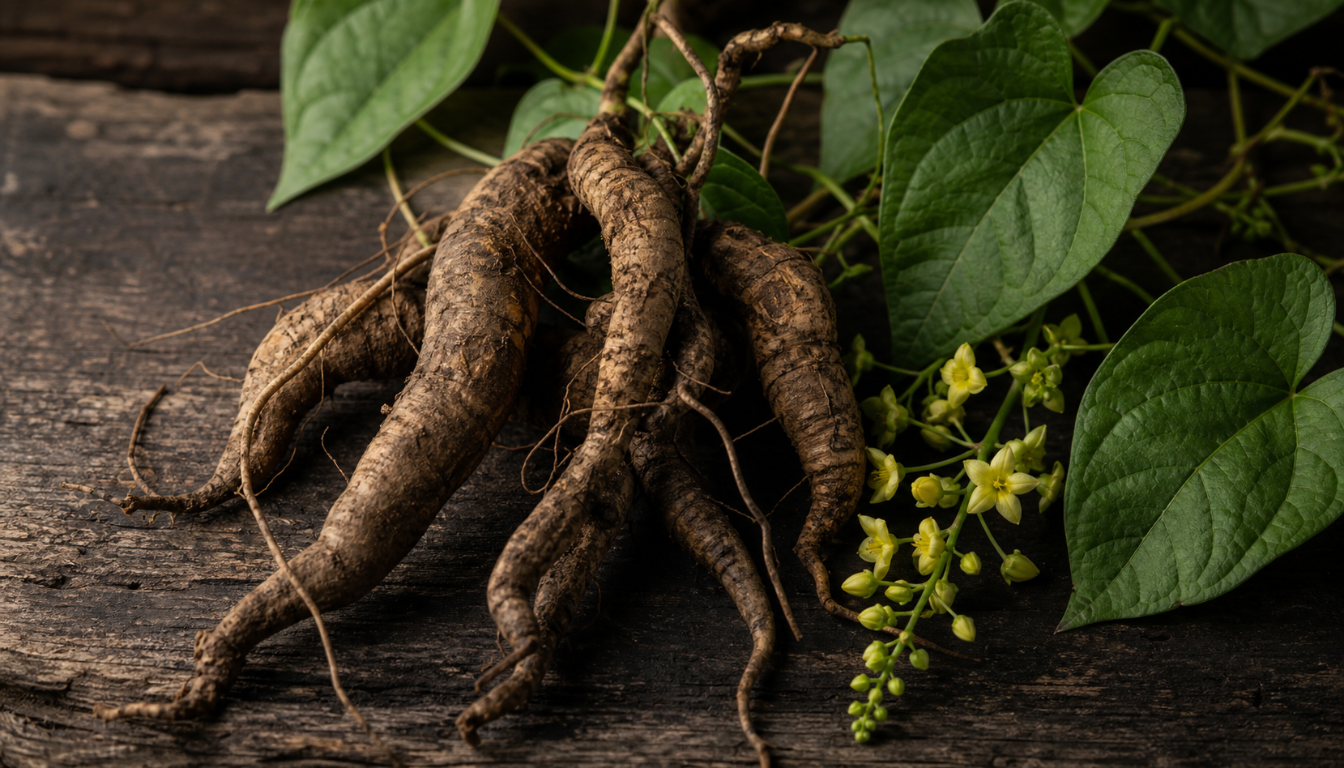
Wild yam (Dioscorea villosa) is a climbing vine native to North America, particularly the eastern and midwestern United States, as well as parts of Latin America, China, Africa, and India. It grows in moist soils, climbing over shrubs and trees, with heart-shaped leaves and small yellow flowers. The medicinally active part is the root and rhizome, harvested in autumn.
It goes by many names: Colic Root, Devil’s Bones, Rheumatism Root, Bitter Yam, Barbasco, and China Root. The name Devil’s Bones is thought to refer to its long, thin, twisted roots that meander beneath the soil with a skeletal appearance.
A related species, Dioscorea opposita (Shan yao), has been used medicinally in China, Japan, and Southeast Asia for over 2,000 years. It forms part of the classical Chinese formula known as the Pill of Eight Ingredients, traditionally prescribed for hypothyroidism, nephritis, and diabetes.
The Diosgenin Story
In 1936, Japanese scientists isolated a compound from wild yam root called diosgenin. That discovery changed pharmaceutical history.
Diosgenin is a steroidal saponin, a compound the body cannot directly convert into hormones, but which chemists can. In a laboratory, diosgenin becomes the starting point for synthesising progesterone, estrogen, cortisone, hydrocortisone, and pregnenolone. It was the direct precursor used in the development of the first oral contraceptive pill. Despite the irony, wild yam had no contraceptive effect on its own but its chemistry made modern contraception possible.
Today, wild yam is cultivated throughout Mexico specifically to supply the pharmaceutical industry with diosgenin. The derivatives produced from it are used to treat sex hormone disorders, menopause, premenstrual syndrome, prostate hypertrophy, high blood pressure, Addison’s disease, rheumatoid arthritis, psoriasis, bursitis, sciatica, and contact dermatitis, among others.
Traditional Uses Across Cultures
Long before 1936, healers across three continents had already identified what wild yam root could do. Native Americans used it primarily as an antispasmodic, for colic, bowel cramps, and abdominal pain. The Aztec and Maya used it for pain relief and, according to historical accounts, as a method of fertility management.
Reports suggest that consuming the root daily for over two months created resistance to fertilisation without disrupting ovulation or the menstrual cycle. When the woman wished to conceive, she stopped taking it and fertility returned within a month. Whether this reflects a genuine pharmacological effect or cultural belief remains debated, but it is a remarkable piece of ethnobotanical history.
In Chinese medicine, Shan yao has been prescribed continuously for two millennia, valued not just medicinally but eaten as a vegetable across Asia.
Wild Yam Root Benefits: What I Use It For Clinically
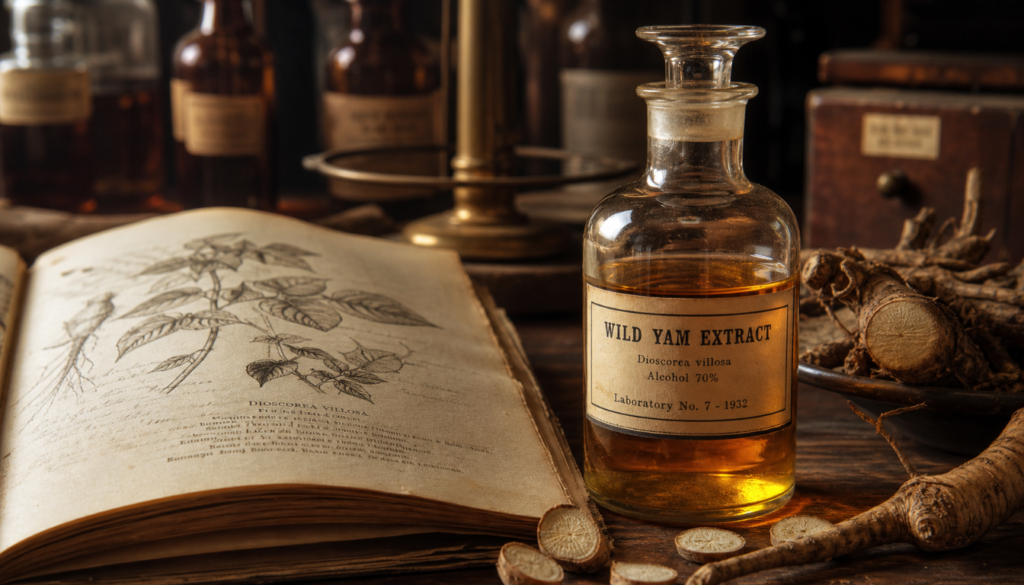
In my clinical practice, wild yam root is one of my first considerations for the following conditions:
- Menstrual and uterine cramps – its antispasmodic action on the smooth muscle of the uterus and abdomen is reliable and well-documented in traditional use
- Bowel spasms and irritable bowel – the relaxing effect on abdominal muscles makes it useful where cramping is a primary symptom
- Pregnancy support – wild yam has traditionally been used to ease pregnancy pain, nausea, and cramping, and to reduce the threat of miscarriage; it also relieves uterine cramping in the third trimester
- Rheumatic and arthritic conditions – the saponins in the outer bark, including dioscin, have anti-inflammatory and muscle relaxant properties that address arthritic and rheumatic pain directly
- Nervous system – wild yam is genuinely relaxing to the nervous system; I have used it successfully with patients who become easily agitated or overstimulated
- Wild yam root menopause support – its phytoestrogenic properties may help ease hot flashes and mood swings, though I always recommend discussing this with a doctor before use alongside any HRT
Forms, Dosage and Cautions
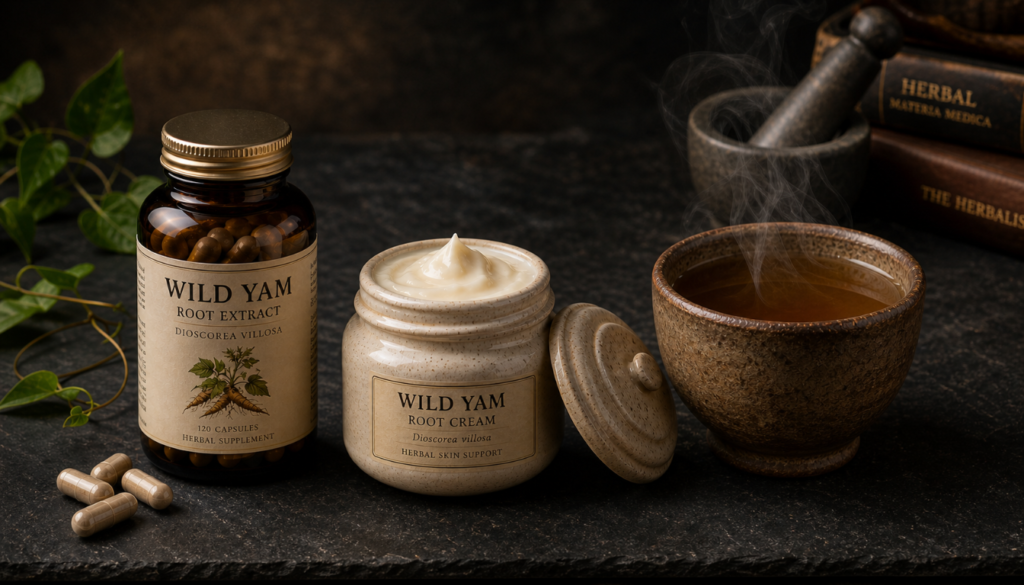
Wild yam root is available as capsules, creams, teas, and powders.
- Capsules provide the most standardised dose and are what I recommend for most patients. Choose a reputable brand with clear diosgenin content labelling.
- Creams are used topically for localised pain and inflammation. Apply to clean, dry skin following label instructions.
- Teas are a traditional preparation – steep dried root in hot water. The dose is less concentrated than capsules but appropriate for mild symptoms and nervous system support.
- Start low and increase gradually. This minimises digestive adjustment and allows you to assess your individual response.
Important cautions
- Wild yam root may interfere with hormone replacement therapies and oral contraceptives – consult your doctor before combining them
- It can affect liver enzymes and may interact with drugs metabolised by the liver
- Some people experience mild nausea or digestive upset initially
- Pregnant or lactating women, diabetics, and anyone with a hormone-sensitive condition should consult a licensed physician before use
How to Choose a Quality Wild Yam Supplement
Not all wild yam supplements are equal, and the difference matters clinically. Here is what I look for when recommending a product to patients.
Standardised diosgenin content is the most important factor. Look for a product that specifies diosgenin percentage on the label, typically between 6% and 20%. A product that simply lists “wild yam root powder” with no standardisation tells you nothing about the active compound content.
Capsules over plain powder for most people. Standardised capsules deliver a consistent dose. Loose root powder varies significantly in potency depending on harvest time, storage, and processing.
GMP certification – Good Manufacturing Practice means the facility producing the supplement is independently audited for quality and consistency. It is not a guarantee of efficacy but it is a baseline minimum I would not go below.
Avoid proprietary blends that combine wild yam with multiple other herbs without disclosing individual amounts. You have no way of knowing how much diosgenin you are actually getting.
Wild Yam Root vs Wild Yam Cream: What Is the Difference?
This is one of the most common points of confusion I encounter, and it is worth addressing directly.
Wild yam creams are widely marketed as natural progesterone alternatives. Many women buy them expecting a hormonal effect. The problem is that most wild yam creams contain no standardised diosgenin, they use plain wild yam extract, which the body cannot convert into progesterone on its own. The conversion requires a laboratory process that does not happen in human skin or tissue.
If you are using a wild yam cream expecting progesterone-like effects, check the label carefully. Unless it explicitly states it contains USP progesterone or a standardised diosgenin extract, it is unlikely to deliver the hormonal support it implies.
That said, wild yam creams are not useless. Applied topically they can deliver genuine anti-inflammatory and muscle relaxant benefits, particularly useful for localised joint and muscle pain. Just be clear about what you are using it for and what it can realistically do.
When in doubt, discuss with your healthcare provider before choosing between a topical cream and an oral supplement.
Before You Go – Wild Yam Root Benefits
Wild yam root is one of those herbs that rewards attention. The more you understand its chemistry and history, the more remarkable it becomes. It is a plant that shaped both ancient healing traditions and modern pharmaceutical manufacturing.
If you are ready to try it, look for a standardised capsule with clear diosgenin labelling. A reliable option is available here.
For more herbs covered with the same clinical depth, explore my Herbs section.
References – Wild Yam Root Benefits
Little Herb Encyclopedia, by Jack Ritchason; N.D., Woodland Publishing Incorporated, 1995
The Ultimate Healing System, Course Manual, Copyright 1985, Don Lepore
Planetary Herbology, Michael Tierra, C.A., N.D., Lotus Press, 1988
Handbook of Medicinal Herbs, by James A. Duke, Pub. CRP Second Edition 2007
The Complete Medicinal Herbal, by Penelope Ody, Published by Dorling Kindersley
Related Article
The Truth About Vitamins
Frequently Asked Questions – Wild Yam Root Benefits
What is wild yam root good for?
In my clinical practice I use wild yam root primarily for menstrual cramps, bowel spasms, rheumatic pain, and nervous system support. Its antispasmodic and anti-inflammatory properties make it one of the more versatile roots in my dispensary.
Does wild yam root affect hormones?
Wild yam contains diosgenin, which chemists can convert into progesterone and estrogen in a laboratory. However, the human body cannot make that conversion on its own. Its phytoestrogenic properties may still offer mild hormonal support, particularly for menopause symptoms, but it is not a direct hormone replacement.
Can I take wild yam root during pregnancy?
Traditionally yes, it has been used to ease pregnancy nausea, cramping, and to reduce miscarriage risk. However, I always recommend consulting your physician before taking any herbal supplement during pregnancy.
Does wild yam root interact with medications?
It can interact with hormone replacement therapies, oral contraceptives, and drugs metabolised by the liver. Always consult your doctor before combining wild yam root with any existing medication.
What is the best form of wild yam root to take?
For most people I recommend capsules with clear diosgenin content labelling. Creams work well for localised pain. Teas are suitable for mild symptoms and nervous system relaxation.