
The Herb Prof Team researches and writes our herbal guides, drawing on published research, traditional herbal references, and hands-on growing experience.
Lemon balm is one of the most rewarding herbs to grow, but it has one frustrating quality. It peaks fast and fades faster. If you have ever watched a bumper summer harvest wilt in the fridge within a week, you already know the problem. Knowing how to preserve lemon balm correctly makes the difference between a year-round supply and a wasted harvest.
This guide covers every practical preservation method in full detail, with exact timings, the best containers for each method, and honest shelf life figures so you can keep lemon balm’s flavour, aroma, and therapeutic compounds intact for months.
Why Preserve Lemon Balm
Fresh lemon balm leaves last just five to seven days in the refrigerator before the volatile oils that carry its characteristic citrus scent begin to degrade. Those same volatile oils citral, linalool, and geraniol, are responsible for both the culinary flavour and the calming therapeutic properties the herb is valued for.
Preserving lemon balm correctly protects these compounds and gives you a year-round supply for teas, cooking, tinctures, and herbal remedies without relying on shop-bought dried herb that may be months old before it reaches you.
In fact, the best time to harvest for preservation is in the morning after the dew has dried, just before the plant comes into flower. This is when the volatile oil concentration in the leaves is at its peak. Once the plant flowers, the flavour and potency of the leaves decline noticeably.
Preservation Methods
Method 1: Drying
Drying is the most straightforward preservation method and produces lemon balm that is shelf-stable for up to six months. It works well for teas, culinary use, and as the base for homemade tinctures made later in the year.
How to dry lemon balm:
- Harvest stems in the morning, cutting just above a leaf node to encourage regrowth
- Rinse gently under cold water and shake off excess moisture
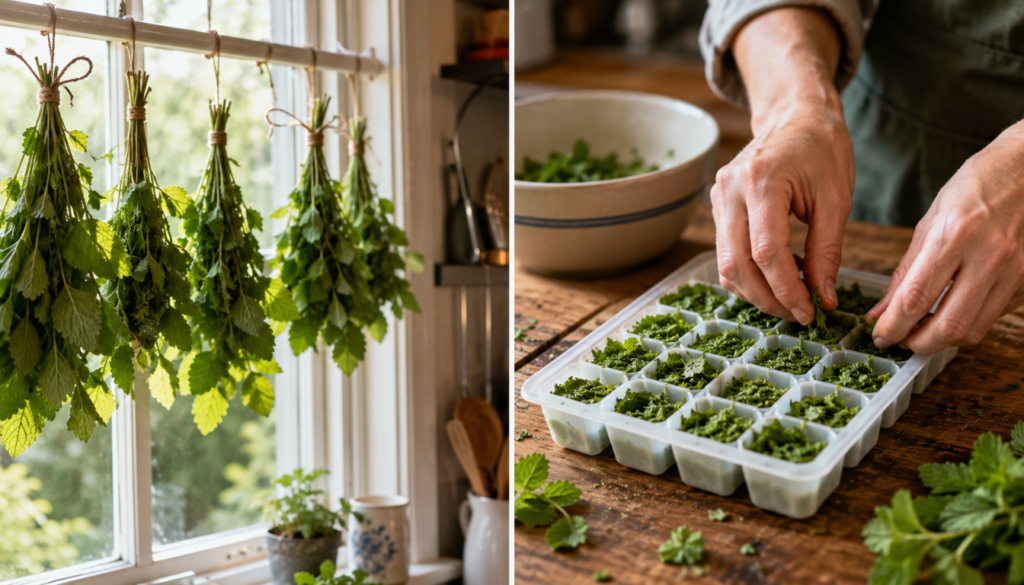
- Tie stems into small bundles of five to eight and hang upside down in a warm, well-ventilated space away from direct sunlight, a dry kitchen, airing cupboard, or covered porch all work well
- Allow to dry for one to two weeks. The leaves are ready when they crumble easily between your fingers without feeling leathery
- Strip the dried leaves from the stems and store in airtight glass jars away from light and heat
Air drying vs dehydrator: If you are short on time or live in a humid climate, a food dehydrator set to 35°C (95°F) reduces drying time to two to four hours. Avoid temperatures above 40°C as heat degrades the volatile oils that give lemon balm its flavour and therapeutic value.
Shelf life: Up to six months in an airtight glass jar stored away from light.
Method 2: Freezing
Freezing preserves the fresh flavour and colour of lemon balm far better than drying and is the best method for culinary use, sauces, dressings, soups, and smoothies. It is less suitable for teas as the texture of thawed leaves is soft.
How to freeze lemon balm:
Option A: Ice cube method (best for cooking)
- Wash and thoroughly dry the leaves
- Chop finely or blend briefly
- Pack into ice cube trays and cover with water or olive oil
- Freeze until solid, then transfer cubes into labelled freezer bags
- Drop directly into dishes while cooking, no thawing required
Option B: Dry freeze (best for tinctures and teas)
- Wash and dry the leaves completely as any residual moisture causes freezer burn
- Spread in a single layer on a baking tray and freeze for two hours
- Transfer to airtight freezer bags, squeeze out all air, and seal
- Label with the date and use within 12 months
Shelf life: Up to 12 months when stored in airtight bags with all air removed.
Method 3: Infusing in Oil
Lemon balm infused oil is a versatile kitchen staple that works beautifully in salad dressings, marinades, drizzled over fish or grilled vegetables, and as a base for homemade skincare preparations.
How to make lemon balm infused oil:
- Wash fresh lemon balm leaves and dry them completely as any moisture in the oil risks mould growth
- Pack the dried leaves firmly into a clean sterilised glass jar
- Cover completely with a mild-flavoured oil: extra virgin olive oil, sunflower oil, or sweet almond oil all work well
- Seal and place in a cool, dark cupboard for two weeks, shaking every two to three days
- Strain through cheesecloth into a clean bottle, pressing the leaves firmly to extract all the oil
- Label with the date and store in the fridge
Important safety note: Always ensure leaves are completely dry before infusing in oil. Fresh leaves contain water that creates the conditions for bacterial growth, including Clostridium botulinum, in an oxygen-free oil environment. When in doubt, use dried leaves rather than fresh.
Shelf life: Two to three months refrigerated.
Method 4: Infusing in Vinegar
Lemon balm vinegar is sharp, aromatic, and excellent in salad dressings, shrubs, and marinades. Apple cider vinegar is the most complementary base, its mild sweetness balances lemon balm’s citrus notes well.
How to make lemon balm vinegar:
- Pack fresh or dried lemon balm leaves into a clean glass jar
- Cover with apple cider vinegar or white wine vinegar
- Seal with a non-metal lid as vinegar corrodes metal lids over time. Use a plastic lid or place cling film between the jar and a metal lid
- Store in a cool, dark place for two weeks, shaking every few days
- Strain and bottle in a clean glass jar
Shelf life: Up to six months stored in a cool, dark cupboard.
Method 5: Making a Tincture
A tincture is the most concentrated and longest-lasting preservation method. It extracts both the water-soluble and fat-soluble active compounds from lemon balm into alcohol, producing a preparation that retains full therapeutic potency for two to five years. For the complete step-by-step tincture method, dosage guidance, and safety notes, see our Lemon Balm Tincture Recipe: How to Make It at Home.
Method 6: Lemon Balm Syrup
For a fast culinary preservation option, a simple syrup captures lemon balm’s fresh flavour in 15 minutes. Combine equal parts sugar and water in a saucepan, heat until dissolved, add a large handful of fresh lemon balm leaves, and steep off the heat for 10 minutes before straining. Store refrigerated in a glass jar for up to two weeks. Finally, use to sweeten teas, cocktails, lemonade, or as a drizzle over desserts.
Shelf life: Up to two weeks refrigerated.
Method 7: Preserving in Salt
Lemon balm herb salt is one of the most practical preservation methods for culinary use. It keeps indefinitely refrigerated and doubles as a ready-made seasoning for fish, chicken, salad dressings, and roasted vegetables.
How to make lemon balm herb salt:
- Wash and thoroughly dry fresh lemon balm leaves as moisture causes the salt to clump
- Roughly chop the leaves by hand and avoid a food processor as it turns them to paste
- Mix the chopped leaves with coarse sea salt at a ratio of approximately 1 part herb to 4 parts salt
- Pack into a clean glass jar, seal tightly, and refrigerate
- Shake daily for the first week as the mixture reduces in volume
- Transfer to a smaller jar once settled and use as needed
Shelf life: Indefinitely when refrigerated. The salt draws moisture from the leaves and acts as a complete natural preservative.
Storage at a Glance
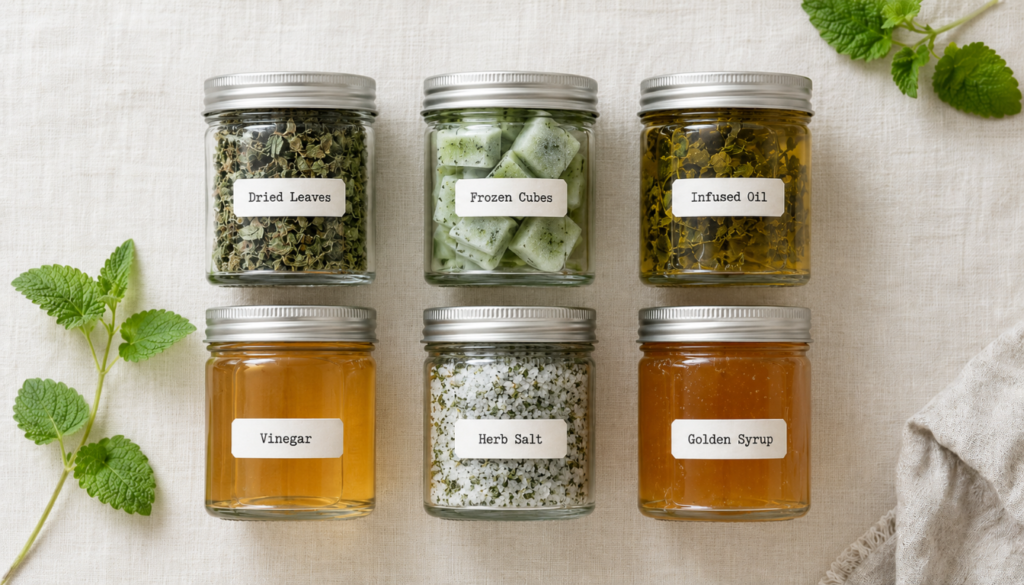
| Method | Best Container | Location | Shelf Life |
|---|---|---|---|
| Dried | Airtight glass jar | Dark cupboard | 6 months |
| Frozen ice cubes | Freezer bag | Freezer | 12 months |
| Frozen dry | Airtight freezer bag | Freezer | 12 months |
| Infused oil | Dark glass bottle | Fridge | 2–3 months |
| Infused vinegar | Glass jar, non-metal lid | Cool dark cupboard | 6 months |
| Herb salt | Glass jar | Fridge | Indefinitely |
| Syrup | Glass jar | Fridge | 2 weeks |
| Tincture | Dark glass dropper bottle | Cool dark cupboard | 2–5 years |
Harvesting Tips for Better Preservation
How you harvest directly affects how well lemon balm preserves. A few habits that make a measurable difference:
- Harvest before flowering, once the plant flowers, volatile oil content in the leaves drops significantly
- Harvest in the morning after dew has dried but before midday heat begins to evaporate the essential oils
- Cut above a leaf node as this encourages the plant to regrow and gives you multiple harvests across the season
- Never harvest more than one third of the plant at once. This keeps the plant healthy and productive through the season
Before You Go – How to Preserve Lemon Balm
Preserving lemon balm well comes down to matching the method to the intended use. Drying suits teas and long-term storage. Freezing suits cooking. Oil and vinegar infusions suit the kitchen. A tincture suits anyone who wants the full therapeutic benefit of the herb available on demand for years. With any of these methods in place, a good summer harvest carries you comfortably through to the following season.
For everything else lemon balm can do, its health benefits, therapeutic uses, and culinary applications, our Lemon Balm: Health Benefits, Uses and How to Use It covers the full picture in one guide.
References – How to Preserve Lemon Balm
Little Herb Encyclopedia, by Jack Ritchason; N.D., Woodland Publishing Incorporated, 1995
The Ultimate Healing System, Course Manual, Copyright 1985, Don Lepore
Planetary Herbology, Michael Tierra, C.A., N.D., Lotus Press, 1988
Handbook of Medicinal Herbs, by James A. Duke, Pub. CRP Second Edition 2007
The Complete Medicinal Herbal, by Penelope Ody, Published by Dorling Kindersley
Related Articles
How to Make Coconut Oil at Home: A Simple Step-by-Step
Permaculture Zones: A Guide to Sustainable Gardening
Frequently Asked Questions – How to Preserve Lemon Balm?
What is the best method for preserving lemon balm?
The best method depends on how you plan to use it. Drying is best for teas and long shelf life. Freezing is best for cooking. A tincture is best for therapeutic use and lasts two to five years. All methods are straightforward and require no specialist equipment.
When is the best time to harvest lemon balm for preservation?
Harvest in the morning after the dew has dried, just before the plant comes into flower. This is when volatile oil concentration in the leaves is at its highest, giving you the most flavour and therapeutic potency in your preserved herb.
How long does dried lemon balm last?
Dried lemon balm stored in an airtight glass jar away from light and heat lasts up to six months. After that it is still safe to use but the flavour and potency will have declined noticeably.
Can I freeze lemon balm without water or oil?
Yes. The dry freeze method, spreading leaves on a tray, freezing for two hours, then transferring to airtight bags works well and avoids diluting the herb with water or oil. It is the better option if you plan to use the frozen herb for teas or tinctures.
Is lemon balm infused oil safe to make at home?
Yes, provided the leaves are completely dry before infusing. Fresh leaves contain water that can create conditions for bacterial growth in an oxygen-free oil environment. Always use thoroughly dried leaves, keep the finished oil refrigerated, and use within two to three months.
Can I preserve lemon balm in honey?
Yes. Pack fresh or dried lemon balm leaves into a jar and cover completely with raw honey. The low water activity of honey naturally preserves the herb. Lemon balm honey is excellent stirred into tea, spread on toast, or used as a natural remedy for sore throats. It keeps for up to 12 months stored at room temperature away from direct light.